Qualcomm’s flagship chipsets have been the gold standard silicon for a while now. At least for Android phones. But some people arguably don’t need all this processing power.
As the American chipmaker’s annual chip launch draws ever closer, we expect the new high watermark Snapdragon 875 to make its debut. More importantly, for those not planning a top-tier smartphone purchase in 2021, a “lite” version of this chipset is also rumored to debut.
It got us thinking, would it be such a bad thing if Qualcomm split its flagship 800-series in two? We asked readers if they’d welcome the addition of a lite Snapdragon flagship SoC to bolster its ranks. Here’s what you told us.
Would you like to see a Lite version of Qualcomm’s flagship processors?
Results
A hefty majority love the idea of a lite flagship SoC. Of the more than 1,400 votes cast, 83.7% of voters feel Qualcomm should ship a Snapdragon 875 Lite in 2021. As Hadlee Simons argues in this extensive piece, a lite flagship chipset would go a long way to address the gulf in performance between the true mid-range and expensive top-tier.
Qualcomm’s moat between the 700- and 800-series silicon may be too large for some OEMs, leaving them to choose between compromising on features or overextending on price. We’ve seen a slew of phone makers opt for Snapdragon 765G on their experimental or flagship phones in 2020, likely to keep costs in check. The LG Velvet and $999 LG Wing are two such examples.
That said, some feel a lite flagship chipset won’t do much for the industry. Around 250 votes were cast against the introduction of cheaper top-tier silicon. Judging by the comments, it’s clear readers have their own solutions.
Here’s what you have to say
Dt Bell: You’re sort of black and white about your survey. Yes, it would be a great addition. No, there’s no need for it. There should be a center statement with “MEH” in.
kfjm254: Anyone else thinking MediaTek Dimensity 1000/800 series??? I mean they are more powerful compared to the 765 and just @ par with the 855… That’s the chip you are looking for, you just need to get over “soc racism”.
Tech Fan: Yeah, that would be great especially for the regular flagships (non-plus/pro/ultra) which can make them more affordable and closer to the “flagship killer” concept without compromising on other aspects such as display quality, camera, battery, build, etc. and still having decent and almost flagship-level performance with maybe less power consumption.
sonicsynth2000: Why not release devices in 2021 with the current 865 or even 855? 875 lite could potentially be cheaper than actual 875, but still be more expensive (and might perform worse) than the existing 865.
That’s it for this poll. Thanks for your votes and comments. If you have any additional thoughts, please drop them down below.
Barely more than 6 months after the arrival of its Moto G8 range, Motorola has already started to market its Moto G9 range. The main model, the Moto G9 Plus, and the more basic variant, the Moto G9 Play, debuted in September, showing evolution in a good chunk of its specs, although there have been cuts.
Rumors Nov 11
Motorola November 10
The Moto G9 Power model, known for its rugged battery, hit the European market last week, receiving simple upgrades in a good chunk of its configurations except for the battery, which has a generous 6000mAh. The Power series is very popular in Brazil, and it looks like its latest member is finally about to land here.
With model number XT2091-4, the Motorola Moto G9 Power received its approval by Anatel on Wednesday (11). Unfortunately, despite the certification, there is still no information on the price and release date of the device here. However, given that it is already free to operate in the country, it should be announced soon.
In addition to the huge 6000mAh battery with 20W fast charging, the Motorola Moto G9 Power is equipped with an 8-core Qualcomm Snapdragon 662 processor running at 2.0 GHz, 4 GB of RAM, 128 GB of expandable storage, 6.8 IPS “LCD display with HD + resolution, 16MP front camera, set of three rear lenses with 64MP main sensor, 2MP macro and 2MP depth and Android 10.
Technical specifications
6.8 inch IPS LCD screen with HD resolution + Perforated display Snapdragon 662 processor 4 GB RAM 128 GB internal storage Expandable memory with MicroSD card 16 MP front camera (f / 2.2) Three rear cameras 64 MP main sensor (f / 1.8) 2 MP macro sensor (f / 2.4) 2 MP depth sensor (f / 2.4) Dual SIM, NFC, P2 port and USB-C battery with 6000mAh capacity and 20W Android 10 fast charge running under Motorola interface The Motorola Moto G9 Power is not yet available in Brazilian stores. To be notified upon arrival.
This shouldn’t be too surprising if you’ve been following mobile SOC (system on a chip) news for the past year or two. The Snapdragon 7c (and higher performing 8c) chipset was announced nearly a year ago. It’s based on an 8nm process and has 8 computing cores: Two Cortex-A76 cores with up to a 2.4 GHz clock speed and 6 low-power Cortex-A55 chip cores.
More efficient process and a newer architecture
Both of the newer MediaTek chips for Chromebooks either meet or exceed potential performance based on more recent ARM architecture designs and/or a more power-efficient build process that can pack more transistors into the same space.
Let’s start a 7c comparison with the M8195, which is the higher-end of the two new MediaTek chipsets.
It’s built on TSMCs 6nm process, so there are immediate power efficiency gains available simply based on the transistor density. Like the Snapdragon 7c, it has 8 CPU cores. Unlike the 7c are the configuration and ARM architecture. The M8912 has four high-power Cortex-A78 cores and four of the same Cortex-A55 cores as the 7c.
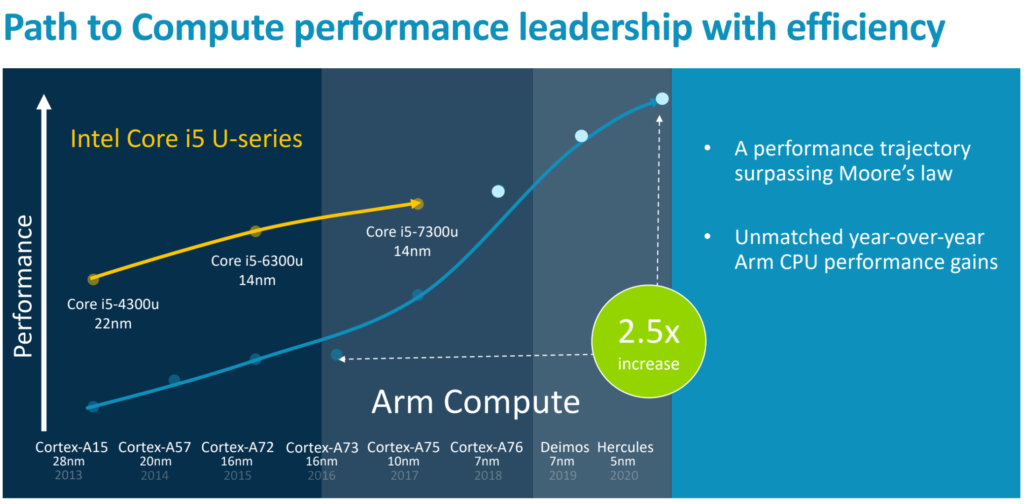
Just to add more context about those four Cortex-A78 cores, consider the CPU roadmap ARM shared back in 2018:
You can see that Cortex-A76 chips such as those used in the Snapdragon 7c were a nice expected upgrade over chips using older architectures. But the Cortex-A78’s in MediaTek’s new SOCs will bring another leap in performance.
Even the lower-end MT8192 is no slouch by comparison to the Snapdragon 7c. It uses the same Cortex-A76 cores but has four instead of two. Of course, that means having two fewer of the more power-efficient Cortex-A55 cores.
So what does all this mean for ARM-based Chromebooks?
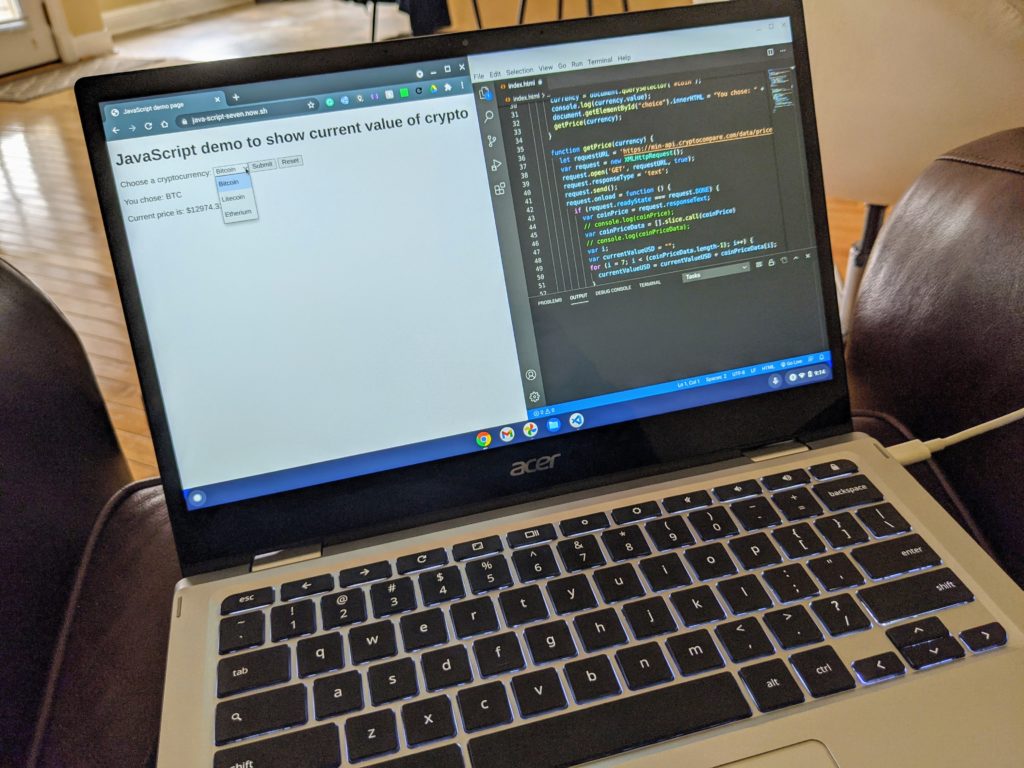
Acer Chromebook Spin 513 running Chrome and Visual Code in Linux
When they do, however, you’ll have a choice to make if you want a new ARM-based Chromebook. Much of that will depend on the prices between Qualcomm- and MediaTek-powered devices, and we don’t know that yet. We do know if you want integrated LTE, you’ll likely opt for the Acer: Qualcomm’s integrated modems are among the best in the business.
But if you want more performance or features such as the ability to drive three displays and have support for Dolby Vision and 7.1 surround sound (found in the MT8195) or a full-HD display at 120Hz, you might want to take a new MediaTek-powered Chromebook for a spin. Think of at least a step-generation improvement in performance as compared to the already capable Lenovo Chromebook Duet, which runs on a MediaTek MT8183.
Either way, we’re finally starting to see real progress and potential in ARM-based Chromebooks. Up to now if you wanted one with mid- to high-end performance, Intel was your likely your first and only choice. In 2021, you’ll have another chip contender worth considering.
Prior to writing and translating for Notebookcheck, I worked for various companies including Apple and Neowin. I have a BA in International History and Politics from the University of Leeds, which I have since converted to a Law Degree. Happy to chat on Twitter or Notebookchat.
Review: New Amazfit GTS 2 and GTR 2 have big upgrades over previous models
These two Amazfit watches may look different but they have identical operating systems, health tracking and other features, so we're reviewing them together. With built-in GPS, speakerphone, music storage, voice commands, SpO2 tracking and more, these affordable watches are worth buying — with some caveats.
It was reported in September that due to the revised US ban, Taiwan-based TSMC could not cooperate with Huawei. Hence, TSMC was unable to produce Kirin 9000 and other Kirin chipsets for the Chinese company. It was recently reported that Qualcomm has confirmed applying for a license to supply chipsets to Huawei. A fresh report by China’s 36k.com publication (via MyDrivers) has claimed that Qualcomm has been granted permission.
Huawei is known for using the homegrown Kirin chipsets to power its smartphones. The Chinese firm did not manufacture the chipsets, but it only designs semiconductors through its HiSilicon division. The actual manufacturing is carried out by TSMC. Since TSMC make use of US-made equipment for manufacturing those chipsets, it was stopped from doing business with Huawei. Hence, in August, Huawei Consumer Business CEO, Yu Richard claimed that the Mate 40 series could be the last Kirin SoC powered phones from the brand.
Recent reports have revealed that companies like Intel, AMD, Samsung Display, Sony, and others have been granted permission by the U.S. government to continue business with Huawei. Hence, there can be a possibility that TSMC may resume making chips for Huawei. Meanwhile, it appears that Qualcomm will supply chips to the Chinese firm.
According to the Chinese publication, a source close to Huawei has said that Qualcomm has already bagged a license to supply chips to Huawei. If TSMC is unable to do business with Huawei, its high-end lineup such as P-series and Mate-series could be fueled by flagship Snapdragon chipsets. There is a possibility that the Huawei P50 series arriving in Q1 could be driven by the Snapdragon 875 chipset.
There is a high demand for the recently announced Mate 40 series. However, it is mainly because of the limited availability of the Kirin 9000 chips, Huawei is reportedly unable to manufactureMate 40 Pro and Mate 40 Pro Plus smartphones. Hence, there are speculations that the company may temporarily sell Snapdragon 875 powered Mate 40 models.
Apart from Snapdragon chips, Huawei is also expected to launch MediaTek powered phones in the absence of Kirin chips. It was reported last week that Huawei managed to secure a big stock of MediaTek’s Dimensity chipsets before September.
The Xiaomi smartphone with model number M2012K11C is expected to be the Mi 11.
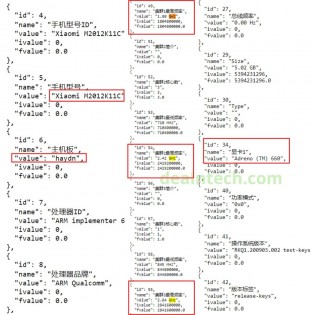
Xiaomi is working on a smartphone that is likely to feature the upcoming Qualcomm Snapdragon 875 processor. A new Xiaomi smartphone with the model number M2012K11C has appeared on Geekbench, revealing some key details. The source code also mentions the presence of Adreno 660 GPU that is likely to be paired with Snapdragon 875 SoC for graphics.
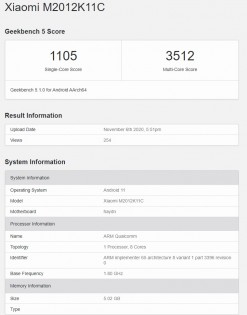
The Xiaomi smartphone with model number M2012K11C is expected to be the Mi 11. The smartphone was spotted on Geekbench 5, which managed to score 1,105 and 3,512 in single-core and multi-core tests. The listing further reveals that M2012K11C gets powered by a Qualcomm Snapdragon 875 processor.
The source code, according to MySmartPrice, further reveals that the smartphone will feature Adreno 660 GPU. The current flagship Snapdragon 865+ processor comes with Adreno 650 for graphics.
Qualcomm will launch the Snapdragon 875 chipset on December 1 at the Qualcomm Summit, which will be held virtually. Details of the mobile flagship processor were leaked last month, which revealed the Snapdragon 875 processor will be based on a 5nm architecture and will have a clock speed of 2.84GHz.
Xiaomi is likely to unveil the Mi 11 series in China during Q1 2020. Rumours suggest that the smartphone will feature 6GB RAM and run on Android 11 out of the box. Other details of the Mi 11 series are currently unknown.
It’s almost time for Qualcomm to hold its annual Snapdragon Summit again, where the chipmaker details its newest flagship processor that will appear in the following year’s phones. We’re all expecting the Snapdragon 875 to be unveiled this year, picking up where the Snapdragon 865 left off.
There have also been some murmurs of a Lite version of its flagship processor, purportedly dubbed the Snapdragon 870, which could be a Snapdragon 865 Plus with a higher clock speed (3.2Ghz or higher).
Regardless of what Qualcomm finally shows off come December, a Snapdragon 870 or a “Snapdragon 875 Lite” makes a lot of sense for the company and the smartphone industry in general.
The state of Snapdragon
Before we can understand why a Lite version of the Snapdragon 875 would make sense, we first need to take a look at the current state of Qualcomm’s top-tier silicon.
The Snapdragon 865 has represented a rather controversial entry in Qualcomm’s flagship chipset history. Sure, you’ve got features like unlimited 960fps recording, 8K video recording, world-class graphics, and mmWave 5G with super-fast speeds. But the biggest strike against the chipset has been its price, with it reportedly delivering a steep increase over last year’s Snapdragon 855 series. In fact, Xiaomi stated that chipset and modem costs for the Mi 10 series doubled compared to last year’s Mi 9.
As a result, we saw very few affordable flagship-style devices with Qualcomm’s top chipset in 2020. While Samsung bucked the trend with the extremely competitively priced Galaxy S20 FE, we saw many flagship killer-like phones increase in price. To name just a few examples, the Xiaomi Mi 10, OnePlus 8, Poco F2 Pro, and Realme X50 Pro were all more expensive than their predecessors.
Between the reported cost of the Snapdragon 865 series, the use of expensive mmWave 5G in some markets (adding up to $100 more for a mmWave variant), and the lack of any genuine rival silicon on the market, it’s no wonder that we saw several brands go with upper mid-range silicon instead of paying the premium.
The increased price of the Snapdragon 865 has forced some brands to jump to upper mid-range silicon.
More specifically, we saw Qualcomm’s cheaper Snapdragon 765G processor become the go-to for flagship-lite devices, most notably with the Google Pixel 5 and the LG Velvet. It’s easy to understand the thinking too. The mid-range chipset delivers good performance for everyday use, as well as many high-end features that match the Snapdragon 865 like 5G, fast charging, high-resolution camera support, and high refresh rate capabilities.
There is one major weakness for the Snapdragon 765G though, and that’s in the GPU arena.
Bridging the graphics gap
Our own testing has shown that the Snapdragon 765G is weaker than even 2018’s Snapdragon 845 flagship processor when it comes to graphical performance. Those hoping to play power-hungry games or retro games via emulators at the best possible quality might be disappointed. But how many people want this from their phones, right?
Unfortunately, this gulf in GPU power is particularly pertinent in 2020 and will continue to be so in 2021 and beyond as high refresh rate screens drive up performance requirements. We ran GFXBench on the Pixel 5 and another much talked about Snapdragon 765G phone with a 90Hz display — the OnePlus Nord. The results clearly show that the chipset isn’t able to drive the most technically advanced software at more than 60fps. In fact, the Pixel 5 in particular falls just short of 30fps in the Manhattan test. By comparison, the Asus ROG Phone 2 and Nubia Red Magic 3 — two phones from 2019 with Snapdragon 855 series chipsets and high refresh rate displays — were both able to get much closer to their target frame-rate.
Benchmarks don’t correlate directly to everyday performance of course, and you’d expect better performance in web browsing, system navigation, and lightweight games on a phone like the Pixel 5 or the OnePlus Nord.
However, it does lead us to think that many 3D games with high refresh rates won’t turn in stable performance. Between PUBG Mobile, Fortnite, and other pending console/PC ports, you might have to settle for 60fps or even lower in some titles.
So, how do you bridge the GPU gap between the affordable 700 series and the premium 800 series? That’s where a Snapdragon 875 Lite could make a big difference.
What could a Snapdragon 875 Lite bring to the table?
Credit: Ryan-Thomas Shaw / Android Authority
A Snapdragon 875 Lite with a GPU equivalent to the Snapdragon 865 or perhaps even the 855/855 Plus could go a long way to ensuring that you actually see high frame rates when using a phone with a high refresh rate panel. But graphical performance is only one potential advantage out of several possible upsides.
In addition to narrowing the GPU power gap between the Snapdragon 765G and flagship silicon, a Lite processor with a more advanced CPU could also boost multimedia performance and connectivity capabilities. After all, the Snapdragon 765G only has two heavyweight cores compared to four in the 800 series, lags behind on machine learning power, and lacks support for bleeding-edge features like 8K recording, a super-fast ISP, and LPDDR5 RAM.
A Snapdragon 875 Lite processor could plug a major gap between the 700 series and the 800 series.
Based on this model, a Lite processor would deliver faster and better camera processing (e.g. HDR+), higher resolution multi-frame processing, faster app launching and loading, higher quality video options, and faster, more accurate augmented reality features like face filters.
This would open the door to affordable flagship phones with true flagship power. Expected 2021 phones like the Pixel 6 or LG Velvet 2 could stick to a cheaper price point without sacrificing on performance. The flagship killer may also make a comeback, with OEMs no longer having to choose between needing to pay top dollar for elite performance or heavily compromising on other areas like display, storage, build quality, or the camera experience. Would a phone with a slightly downgraded 800 series processor still qualify as a true flagship killer? That’s a philosophical question for another day.
Loading poll
There are some potential risks with developing a Lite-style processor though. Qualcomm will need to walk a fine line between performance, features, and pricing. The last thing anyone wants is a rebadged Snapdragon 700 series chipset with a higher price tag. A shoddy, pricey Lite release like this could tarnish the Snapdragon 800 family’s reputation. We already see this in the laptop space, as under-powered chips adopt top-tier branding in a bid to gain more sales.
Another risk is if Qualcomm releases a Lite processor that’s virtually identical to the main chipset but significantly cheaper. This could be a major win for consumers but a problem for the chipmaker, resulting in the firm missing out on revenue as OEMs adopt the Lite chip in lieu of the more expensive silicon.
We’ll just have to wait and see what Qualcomm’s plans are when it finally reveals its new processors this December.
Would you like to see Qualcomm release a Lite version of its flagship processors? Let us know via the poll above!
An unknown Xiaomi device with model designation M2012K11C has appeared on Geekbench. It runs Android 11, has 6GB RAM onboard, and is powered by a Qualcomm chip, which is likely the yet-to-be-announced Snapdragon 875 SoC. More so because the source code of the listing mentions Adreno 660 GPU, which is rumored to be a part of the Snapdragon 875 and isn't available on the current Snapdragon chips.
The M2012K11C - which is said to be the Mi 11 - achieved a score of 1,105 and 3,512 in Geekbench 5's single and multi-core tests, respectively. Since this is possibly a prototype, we'll likely see improved performance of the Snapdragon 875 upon release.
Xiaomi M2012K11C with Snapdragon 875 on Geekbench
Qualcomm will announce the Snapdragon 875 SoC on December 1. It hasn't revealed any details about the new flagship chipset yet, but thanks to a reliable leakster we know the 5nm chip will have one Cortex-X1 clocked at 2.84GHz, three Cortex-A78 clocked at 2.42GHz, and four power-efficient Cortex A-55 running at 1.8GHz.
Qualcomm’s next flagship silicon series, set to be called the Snapdragon 875, will likely be unveiled next month. It’s arguably the most important moment for flagship smartphone OEMs and buyers in 2021. The chip will shape the performance graphs of many Android devices to come.
As the successor to the 865, the 875 is expected to bring gains in performance and thriftier battery consumption. But will it challenge the next Samsung Exynos chip, or more importantly, Apple’s A14 Bionic?
We asked readers in a recent poll how they’d like to see Qualcomm improve the Snapdragon 875. Here’s what you told us.
What would you like to see from the Snapdragon 875?
Results
Over 1,000 readers voted on this one, and an overwhelming majority want just one thing: more speed. 51.2% of readers want the Snapdragon 875 to match or blitz the Apple A14 Bionic. That’s a tall order, even if the 875 will debut with a performance-first Cortex-X1 core.
Apple’s new silicon has proven to be faster than the Snapdragon 865 Plus powering the likes of the Samsung Galaxy S20 and Note 20 series, and Asus ROG Phone 3. In fact, Qualcomm’s current flagship chip still lags behind the A13 Bionic on raw performance. The chipmaker has its work cut out to match Apple’s last-gen chip with its forthcoming generation.
Those not wanting to embarrass Apple users would settle for a lower price. 30% of voters wanted to see the Snapdragon 875’s price dropped below the Snapdragon 865. It’s unclear if lower-priced silicon will help stifle ever-increasing flagship smartphone prices, though.
Finally, just 17.6% of readers want Qualcomm to reign in the Snapdragon 875’s power consumption. Longer battery life is always a fair request, especially as 5G and high-refresh rate displays push power cell demands even further.
Here’s what you told us
We asked readers to list what they hope the Snapdragon 875 will bring. One comment stood out.
Users also shared their thoughts in this article about Apple’s widening chipset lead versus Qualcomm’s competition.
Tony Talks: I don’t think it matters anymore honestly. Only the most hardcore of tech enthusiasts truly care. Performance has long been great with almost no discernible difference.
Lamar Taylor: Android phones use inferior Snapdragon chips that a year or 2 behind the A series chips from Apple.
Unicon743: It is sad, but honestly there is not a single android phone, at any price that beats last year’s underclocked A13 inside an iPhone SE. 400$ iPhone SE.
Bubba Jones: Yes, the iPhone is a powerful device and clearly beats Android. In my mind, if someone is not rendering videos, compressing databases, other continuous CPU intensive apps, all the extra power goes to waste.
That’s it for this poll. Thanks for your votes and comments. If you have any additional thoughts about the Snapdragon 875 or its rival silicon, be sure to drop a line down below.
Thanks to a slew of leaks, we know quite a lot about the Qualcomm Snapdragon 875. The upcoming flagship silicon's specifications leaked a few days ago, confirming that it would run ARM's newest Cortex-X1 core, but at relatively conservative speeds. Xiaomi's 2021 flagship -the Xiaomi Mi 11- has just shown up on Geekbench running what is undoubtedly the Qualcomm Snapdragon 875.
The Xiaomi Mi 11's Geekbench listing comes via the Weibo veteran Digital Chat Station, who is the same person who showed us the Qualcomm Snapdragon 875. It manages to net a single-core score of 1,105 and a multi-core score of 3,512. These numbers align perfectly with an earlier Geekbench run of the silicon, although it might be a tad low if others are to be believed. However, its multi-core score seems a tad low, but that is likely due to a host of other factors such as unstable device firmware.
Lastly, Digital Chat Station also uses the Xiaomi Mi 11's Geekbench listing to reconfirm the Qualcomm Snapdragon 875's configuration of one Cortex-X1 (2.8GHz), three Cortex-A78 (2.4GHz), and four Cortex-A55 (1.8GHz) cores. Regardless of how it'll perform in the real world, it is quite clear that the Qualcomm Snapdragon 875 cannot surpass Apple's silicon. It may have a hard time beating the Exynos 2100, too, as Samsung plans on pushing its Cortex-X1 to over 3.0GHz. That shouldn't perturb Qualcomm too much. After all, Samsung is under pressure regain lost ground after the Exynos 990's inability to stand up to the Snapdragon 865.
Details about the Xiaomi Mi 11 are a tad scarce at the moment. Earlier reports have told us that it will come with a 1440p screen clocked at 120Hz and an under-display selfie camera. Xiaomi will probably throw in Samsung's 108MP ISOCELL HM3 sensor along with an array of supporting lenses for good measure. Although Digital Chat Station has repeatedly insisted that Xiaomi is working on 200W fast charging technology, the chances of it debuting alongside the Xiaomi Mi 11 are somewhat low.
Qualcomm will likely announce the Snapdragon 875, its 5nm chip for flagship smartphones, on December 1, and thanks to a spate of rumors, we already know quite a lot about it. Popular Weibo leaker Digital Chat Station has now revealed some more details regarding the SoC.
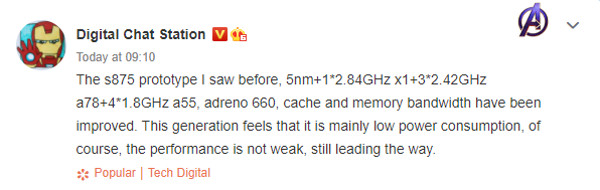
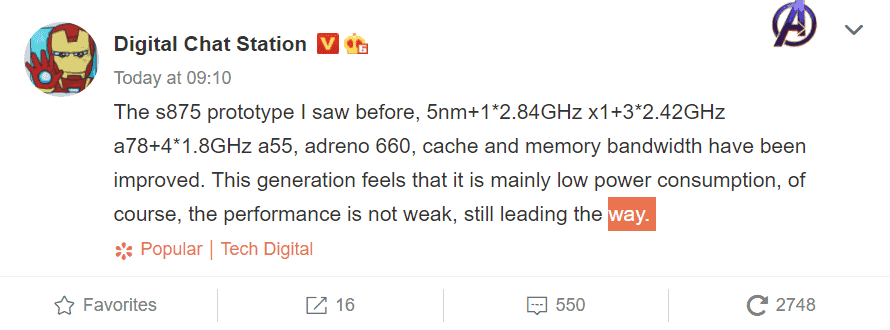
Per the tipster, the Snapdragon 875 has one Arm Cortex-X1 core clocked at 2.84GHz, three Cortex-A78 cores with clock speeds of 2.42GHz, and four Cortex-A55 cores running at 1.8GHz.
In contrast, the Snapdragon 865 features one Cortex-A77 CPU with a frequency of 2.84GHz, three Cortex-A77 cores running at 2.42GHz, and four Cortex-A55 cores clocked at 1.8GHz.
The Snapdragon 865 is based on the 7nm process and its older Cortex-A77 core is some 30 percent slower than the Cortex-X1 CPU when it comes to peak performance. The new Cortex-A78 is also 20 percent faster than the Cortex-A77.
The latest leak also says that the Snapdragon 875 offers improved cache and memory bandwidth, and it is in line with rumors that claimed the new chip would have the Adreno 660 GPU.
And lastly, the leaker also says that the chip is low on power consumption.
According to a benchmark that surfaced recently, the Snapdragon 875 is 25 percent faster than the Snapdragon 865.
The Samsung Galaxy S21 could be one of the first Android phones to feature Qualcomm's new chip. Not all smartphone makers will be jumping on the bandwagon though, as reports claim that Google's next high-end phone, presumably the Pixel 6, will be powered by a proprietary chip, and LG will not release a flagship smartphone in the first half of 2021.
Qualcomm is set to unveil its new flagship Snapdragon 8-series mobile platform on December 1. The upcoming Snapdragon 875 will be the successor to the current-gen Snapdragon 865 SoC. While Qualcomm is yet to announce any details, the latest leak from the Chinese microblogging platform Weibo reveals some key specs of the Snapdragon 875 SoC.
Just like the latest Apple A14 and Huawei's Kirin 9000, the upcoming Snapdragon 875 will also use a 5nm process. It will also compete with the yet-to-be-announced Exynos 2100 SoC from Samsung. According to Digital Chat Station, the CPU on this upcoming silicon from Qualcomm will come in a 1+3+4 tri-cluster design.
Qualcomm Snapdragon 875 mobile platform key specs leaked
It features one Cortex-X1 super core clocked at 2.84GHz, three Cortex-A78 cores clocked at 2.42GHz, and four Cortex-A55 cores clocked at 1.8GHz. While Qualcomm touched the 3GHz mark with the Cortex-A77 cores on the Snapdragon 865+ SoC, it will likely settle with a peak frequency of 2.84GHz on this upcoming chipset.
Advertisement
Based on the previous leaks, the Cortex-X1 could deliver up to 23% higher performance than the Cortex-A78 core. It also comes packed with the all-new Adreno 660 GPU. However, there are no specifics mentioned about the performance output. It will be competing with the Mali-G78 GPU which will be found in the Kirin 9000 and Exynos 2100 chipsets.
Expect to see this chipset in most flagship Android smartphones launching in 2021
The leakster also claims that Snapdragon 875 will have improved cache and memory bandwidth efficiency. Currently, the highest Antutu score on the smartphones launched with the Snapdragon 865 mobile platform is 663,752. Earlier this week, the benchmarks of the Snapdragon 875-powered prototype device leaked online.
It has managed to score 847,868 points in AnTuTu, which is a lot higher than the scores from Snapdragon 865-powered smartphones. While the prototype devices show us the peak performance, the Snapdragon 875 Antutu score on the retail devices could be a lot lesser. For comparison, the Apple A14 on the new iPad Air and iPhone 12 has managed to score 660,038 and 564,899 respectively.
Advertisement
Compared to the Snapdragon 865, this new chipset will be able to deliver high performance with low power consumption. The Snapdragon 875 mobile platform will also come packed with the Snapdragon X60 5G modem. Moreover, it will support both sub-6GHz and mmWave 5G networks.
As usual, the Snapdragon 875 mobile platform will be powering a majority of the Android flagship smartphones launching next year. It might debut with the Samsung Galaxy S21 series launching in January 2021. As the official launch is less than a month away, more leaks might come out soon. Stay tuned!
A new leak may have given us a few Snapdragon 875 details.
The leak apparently details the CPU layout and a few more tidbits.
Qualcomm is holding its Snapdragon Summit early next month, where it’s expected to announce the Snapdragon 875 processor. This will be the latest flagship silicon from the company, and is expected to power a slew of high-end phones in 2021.
Now, frequent leaker Digital Chat Station has posted a few apparent specs on Weibo. More specifically, they claim that the Snapdragon 875 will offer one Cortex-X1 CPU core clocked at 2.84Ghz, three Cortex-A78 cores clocked at 2.42Ghz, and four Cortex-A55 cores clocked at 1.8Ghz. Check out a machine-translated version of the post below.
The leaker also asserts that the chipset is built on a 5nm process, offers an Adreno 660 GPU, and features improved cache and memory bandwidth. Furthermore, they suggest that while performance is still class-leading, the Snapdragon 875 could be focused on lower power consumption instead.
These apparent specs all fall roughly in line with our expectations, as we anticipate a move to the 5nm process and the adoption of Cortex-X1 and Cortex-A78 CPU cores by Qualcomm. Arm says the Cortex-A78 should deliver 20% more power than the Cortex-A77 thanks to general improvements and the smaller manufacturing process (although the former only enables a 7% boost). However, the Cortex-X1 is set to deliver even greater improvements than the Cortex-A78, potentially narrowing the gap between Qualcomm and Apple’s chipsets.
Loading poll
The chipmaker also previously revealed the X60 modem, and history as well as a couple of LinkedInentries tells us that the new modem will appear alongside the flagship processor. It remains to be seen whether this will be an integrated solution though, which would theoretically bring better power efficiency.
What would you like to see from the Snapdragon 875 processor? Let us know by taking the poll above!
Launched in mid-October last year, the iPhone 12 Pro took on rival Galaxy Note 20 Ultra in a speed test to find out which current top of the range can provide the best performance to the user.
The experiment was carried out by the PhoneBuff channel, on YouTube, and used the version of the Samsung smartphone with the Snapdragon 865 Plus chipset. You can view the following results:
Strong points
As it was possible to see, in the first round the iPhone 12 Pro left behind and managed to overtake and open the advantage in the Galaxy Note 20 Ultra from Microsoft tools – Word and Excel. The Apple device was also successful in winning the long run in publisher Adobe Rush and in three of the four games tested.
Samsung’s device managed to be slightly faster, mostly on social media, such as Facebook, and streaming platforms, such as Spotify, ESPN, and Hulu. The difference in the first stage was about 14 seconds less in favor of the iPhone (1:41:12 vs 1:55:46).
In the second round, both phones were able to reopen all background apps. However, even with half the RAM (6GB vs. 12GB), the Apple device managed to multitask faster than Samsung’s competitor (42:99 vs. 46:02).
So what’s your assessment of the speed test results among high-end competitors? Interact with us!
It's been more than 21 months since HMD Global Oy launched the Nokia 9 PureView and now reports are coming that the Finnish company is working on its successor, but will take little more time for its global debut.
It is most likely to be called as Nokia 10 PureView and if sources of the NokiaPowerUser community blog are to be believed, the upcoming handset will have Qualcomm's yet-to-be-announced Snapdragon 875 System-on-Chip (SoC).
Qualcomm is slated to host the annual product launch event in December, and if history is any guide, we will certainly see the unveiling of Snapdragon 865's successor.
Most of the premium Android phones in the market are powered by Snapdragon 865 series chipsets, which can clock peak speed up to 3.1GHz. We expect the 875 series to take the performance up to 50%, speed of operation to several more notches up compared to the predecessor Nokia 9 PureView.
Also, the Snapdragon 875 will be paired with Adreno 660 graphics engine, image processors, and other components to boost on-device intelligence in terms of machine learning and also offer an immersive gaming experience and also enhance the photography experience.
Since Qualcomm Snapdragon 875 is slated to make its official debut in December, we expect the mass-produced chipsets to be ready for assembling them inside the commercial devices only from January 2021 onwards.
Besides Snapdragon 875 processor, Nokia 10 PureView is expected to come with 6.4-inch pOLED PureDisplay with support 120Hz screen refresh rate and will be protected by a sturdy sapphire glass shield.
Inside, it will run Android 11 OS backed by 6GB/8GB/128GB RAM, 128GB/256GB storage, a Penta-camera with ZEISS optics on the back, a 48MP selfie snapper on the front, and a massive 5,000mAh battery with fast charging technology.
Get the latest news on new launches, gadget reviews, apps, cybersecurity, and more on personal technology only on DH Tech.
In mid-October, Samsung’s 5G mobile phone model SM-G9910 passed the 3C certification. This is also the first new Snapdragon 875 officially confirmed smartphone. However, there are reports that this phone will be the first to use this chip globally but not in China.Recently, there have been more revelations about Snapdragon 875.
According to popular Weibo leakster @DigitalChatStation, from the prototype point of view, the Snapdragon 875 uses a 5nm process technology, with one 2.84GHz super-large core, three 2.42GHz A78 cores, and four 1.8GHz A55 cores. Furthermore, the new report also claims that it will use an Andreno 660 GPU. In addition, the leaker claims that the cache and memory bandwidth of this chip will improve. According to previous information, the Snapdragon 875 processor uses a “1+3+4” eight-core design, of which “1” is the super-large core Cortex X1, and its peak performance is 23% higher than Cortex A78.
In conclusion, DigitalChatStation believes that the Snapdragon 875 SoC focuses on lower power consumption. However, this is not to say that the performance will be weak, it is not. In fact, it will still lead.
The code name of this chip is “Lahaina”. Lahaina is the largest census-designated place in West Maui, Maui County, Hawaii. Recall that Qualcomm previously announced that it will hold a Snapdragon chip conference in Hawaii in December. The Qualcomm Snapdragon Technology Summit will hold on December 1. We expect Qualcomm to officially announce the new 5nm flagship Snapdragon 875 chip at this conference.
In addition, @数码闲聊站 also claims that Xiaomi Mi 11 (tentative name) will first launch the Qualcomm Snapdragon 875 flagship chip in China and it will have an “exclusive period” after launch. Outside China, it appears that the Samsung Galaxy S21 will introduce this chip.
Snapdragon 875 hits 847,868 points on AnTuTu
The AnTuTu score of the SD875 shows that it is about 25% better than the SD865. Of course, all expected the Snapdragon 875 SoC to be better but we didn’t think that it will be a huge jump. According to the AnTuTu benchmark, the Snapdragon875 scores 847,868 points. It is not just impressive but unbelievable. For a comparison, Snapdragon 865 scores 663,000 points. The difference between the Snapdragon 865 and 875 about 184,000 points. It is not common to see a difference this big after just one generation. Hence, it’s a big jump for Qualcomm and this will be a good selling point for this chip.