Earlier this week, we heard a rumor that Ryzen 6000 processors based on Zen 3+ won’t be coming in 2021, and there’s now been a further flurry of speculation that AMD will instead be relying on Ryzen 5000 XT CPUs to provide buyers with new options later this year.
The original source for this that we reported on was YouTube leaker RedGamingTech, but now a whole bunch of folks seem to be on board the rumor bandwagon in this case, including fellow YouTuber Moore’s Law is Dead, who highlighted some other rumors on Twitter, as did Wccftech which spotted all this, including the following tweet from ExecutableFix.
I've not seen anything on Warhol. Only that roadmap has mentioned it. Even Phoenix has already been leaked from different places... You can draw your own conclusion based on that 🧐April 27, 2021
See more
The gist of all this recent spinning from the rumor mill is that Ryzen 6000 CPUs codenamed ‘Warhol’, based on Zen 3+ (a refinement of the current Zen 3 architecture for Ryzen 5000 processors), have disappeared off AMD’s recent roadmap for 2021, and no one is hearing about them anymore – so the theory is they’ve been canceled. Instead, Ryzen 6000 is supposedly now arriving in 2022 as Zen 4 chips.
Remember that it is just a theory, and even the rumor mill underlines this, but what the fresh speculation does is point to an alternative, in that rather than leaving a big hole in Team Red’s line-up for 2021, AMD is planning on releasing 5000 XT versions of current processors (which as you’ll no doubt recall, has been done before with XT chips for the Ryzen 3000 range).
APU only?
Moore’s Law is Dead further points out the possibility that in fact, ‘Warhol’ may refer solely to next-gen APUs built on an enhanced version of Zen 3 (not Zen 3+), stating that several of his sources at AMD have said that they haven’t heard a Zen 3+ refresh for Ryzen desktop CPUs is in the cards at all (and indeed running with Zen 3+ was never actually AMD’s plan, anyway).
There are somewhat mixed messages around the rumors about Zen 3+, then, but the overall gist is that it doesn’t seem likely there will be a Zen 3+ refresh in the form of Ryzen 6000 this year, and instead we’ll get Ryzen 5000 XT models – still a refresh, but a more minor one.
According to Moore’s Law is Dead, we may also still see ‘Warhol’ emerge in the form of a new APU, but he sounds pretty doubtful about that, even, and as ExectuableFix points out in the above tweet, AMD ‘Phoenix’ – Ryzen 7000 APUs (Zen 4) – have already been spotted in other rumors, with no sign of ‘Warhol’ now.
The first benchmark results of Intel's yet-to-be-announced eight-core Core i9-11950 'Tiger Lake-H' processor for gaming notebooks have been published in Primate Labs' Geekbench 5 database. The new unit expectedly beats Intel's own quad-core Core i7-1185G7 CPU both in single and multi-thread workloads, but when it comes to comparison with other rivals, its results are not that obvious.
Intel's Core i9-11950 processor has never been revealed in leaks, so it was surprising to see benchmark results of HP's ZBook Studio 15.6-inch G8 laptop based on this CPU in Geekbench 5. The chip has eight cores based on the Willow Cove microarchitecture running at 2.60 GHz – 4.90 GHz, it is equipped with a 24MB cache, a dual-channel DDR4-3200 memory controller, and a basic UHD Graphics core featuring the Xe architecture.
In Geekbench 5, the ZBook Studio 15.6-inch G8 powered by the Core i9-11950H scored 1,365 points in single-thread benchmark and 6,266 points in multi-thread benchmark. The system operated in 'HP Optimized (Modern Standby)' power plan, though we do not know the maximum TDP that is supported in this mode.
CPU
Single-Core
Multi-Core
Cores/Threads, uArch
Cache
Clocks
TDP
Link
AMD Ryzen 9 5980HS
1,540
8,225
8C/16T, Zen 3
16MB
3.30 ~ 4.53 GHz
35W
https://ift.tt/3sS8lZ6
AMD Ryzen 9 4900H
1,230
7,125
8C/16T, Zen 2
8MB
3.30 ~ 4.44 GHz
35~54W
https://ift.tt/3o9Sj9I
Intel Core i9-11900
1,715
10,565
8C/16T, Cedar Cove
16 MB
2.50 ~ 5.20 GHz
65W
https://ift.tt/2QO5Ys7
Intel Core i9-11950H
1,365
6,266
8C/16T, Willow Cove
24MB
2.60 ~ 4.90 GHz
?
https://ift.tt/3ugrFQc
Intel Core i9-10885H
1,335
7,900
8C/16T, Skylake
16MB
2.40 ~ 5.08 GHz
45W
https://ift.tt/2NjBY5l
Intel Core i7-1185G7
1,550
5,600
4C/8T, Willow Cove
12MB
3.0 ~ 4.80 GHz
28W
https://ift.tt/3qHR4jC
Apple M1
1,710
7,660
4C Firestorm + 4C Icestorm
12MB + 4MB
3.20 GHz
20~24W
https://ift.tt/365u3zn
The upcoming Core i9-11950H processor easily defeats its quad-core Core i7-1185G7 brother for mainstream and thin-and-light laptops both in single-thread and multi-thread workloads. This is not particularly surprising as the model i7-1185G7 has a TDP of 28W. Meanwhile, the Core i9-11950H is behind AMD's Ryzen 9 5980HS as well as Apple's M1 in all kinds of workloads. Furthermore, its multi-thread score is behind that of its predecessor, the Core i9-10885H.
Perhaps, the unimpressive results of the Core i9-11950H in Geekbench 5 are due to a preliminary BIOS, early drivers, wrong settings, or some other anomalies. In short, since the CPU does not officially exist, its test results should be taken with a grain of salt. Yet, at this point, the product does not look too good in this benchmark.
It's no surprise that Intel is working on a new big.LITTLE design for its upcoming Alder Lake processors, due later this year. After its breakup with Apple following the introduction of the Apple M1 chip and the announcement of Nvidia Grace last month, Intel is facing increasing competition in market segments where it had long held a dominant position.
This is especially true with one of the largest growing parts of the computer market: laptops. Here, at least according to PassMark Software's CPU benchmark analysis, Intel enjoys nearly 80% of the non-Apple mobile computing market to itself, with AMD struggling to make the kinds of inroads here that it has with desktop CPU market share.
MacBooks make up a relatively small part of the overall mobile computing market, so losing Apple's business is a blow, but not a major one – at least not in a business sense, Intel's ego is another matter.
What would be a major threat to Intel's bottom line is losing a sizeable chunk of laptop PCs to AMD the way it's been hemorrhaging desktop PC installs to AMD's increasingly powerful Ryzen processors. The desktop CPU might be a more prestige, flagship product, but with households needing more than one computer for work and school having several desktop systems can get cumbersome pretty quickly, especially when laptops don't have a mobility premium baked into their price the way they once did.
That's what makes a rumored AMD Zen 5 APU a much bigger deal for Intel than an Apple MX chip could ever be, especially if the chip's rumored specs pan out.
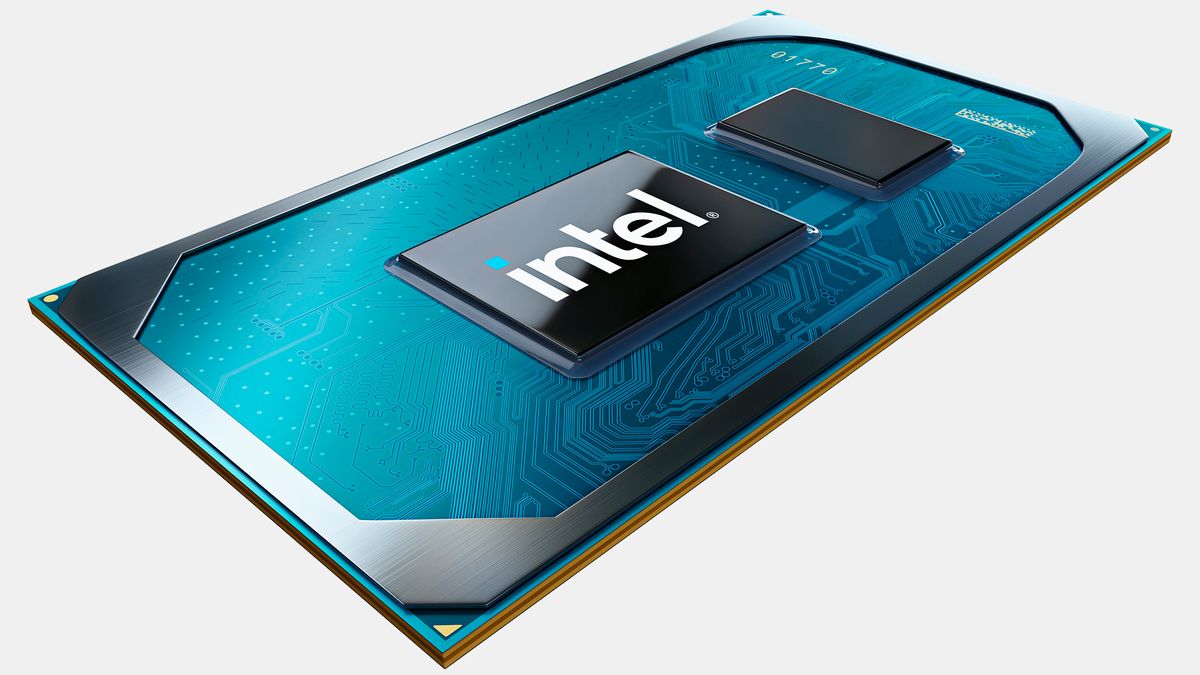
(Image credit: Intel)
Why Alder Lake matters so much to Intel's future
There were mixed reviews for Intel's most recent Rocket Lake-S processors. The Intel Core i9-11900k actually underperformed the previous generation Core i9-10900k in our tests, while the Core i5-11600k is one of the best processors you can get right now for gaming, so overall, the release of Intel's latest desktop processors did not go over as well as AMD's launch of its Zen 3, 5000-series CPUs.
That's not to say Intel has lost the desktop CPU battle for good, especially when it still has the majority of the market by any measure. But AMD is closing in fast and unless something dramatically changes, the two will be going blow for blow for the foreseeable future.
It's simply not the same with laptops, where AMD processors are notable because you can occasionally see them on the shelves at all. The laptop sections of retail floors everywhere are awash in Blue, as are online retailers' stock. While laptop OEMs are working to include more mobile Ryzen processors, they are few and far between. We would know, we review laptops for a living.
Intel's Alder Lake and its successor generations are a solid strategy for locking down the laptop market for the next decade in that they will feature Arm's big.LITTLE architecture, which has a mix of performance and so-called efficiency cores, the first of which are reserved for high-demand apps like Photoshop and gaming, while the latter are designed to handle background tasks that don't need the kind of processing power that current Intel Core processors provide when these tasks get their scheduled processor cycles.
(Image credit: Arm)
This is one of the key innovations that allows devices running on an Arm processor to have outstanding battery life, which is why your smartphone and tablet run on Arm and not Intel or AMD. When Arm is used in a laptop – which has a much larger battery than your phone – getting battery life of more than 24-hours is not uncommon. The drawback has always been that those performance cores haven't been up to the challenge of running heavy duty, desktop-class software.
That is changing, and fast. Apple's initial performance claims for the M1 might have been off-base, but not by much. The new Apple MacBook Air, 13-inch Apple MacBook Pro, and Apple Mac Mini are still pretty powerful machines capable of running a full-service macOS 11 Big Sur and all the apps that come along with it, with developers like Adobe releasing the latest versions of their products with Apple's new processor in mind.
So it's not a matter of if, but when, Windows 10 can effectively run on a big.LITTLE processor. Even though Windows 10 on Arm has been around for some time, Alder Lake is a different matter altogether. It promises to bring the same kind of power you'd find with an Intel Core processor and marry it to the efficiency of an Arm-based chip.
Intel Evo certification for laptop OEMs requires at least nine hours of battery life under Intel's test conditions, but it wouldn't be out of the question to see the next generation of Intel Evo-like certification require 15 hours, or even more, of battery life on Alder Lake chips. When one of the biggest selling points for a customer is a laptop's battery life, this is the kind of advantage that could lock down 80-90% laptop market share for years to come.
Considering that as recently as six months ago archrival AMD was dismissing the idea of moving towards implementing big.LITTLE architecture in its chips, Alder Lake looked like an ace up Intel's sleeve the way Nvidia's RTX and ray-tracing caught Team Red flat-footed when it was released several years ago.
If a recent rumor pans out though, Intel's advantage could vanish much sooner than expected, and they could even end up on the losing end before the decade is out.
Is AMD's Zen 5 the Alder Lake killer?
This week, a rumor surfaced online that AMD was preparing a new hybrid APU running a big.LITTLE design that could be introduced as early as 2024, which would give Intel only about two to three years head start over its rival. Worse still, the new Zen 5 APU is rumored to be using a 3nm node from TSMC, much like what Apple will probably be using for its latest silicon around the same time.
There is some debate about Intel's leaked 2019 roadmap that had the company producing a 3nm node around 2025, so it's not at all certain when and if Intel will be able to hit that production target.
Even if all goes well for Team Blue, TSMC will still be providing 3nm nodes years ahead of Intel, which means an AMD Zen 5 APU could seriously outperform Intel's chips in mobile devices while matching it's power efficiency, putting Intel's laptop chips at a serious disadvantage.
Intel could always just go with TSMC the way Apple and AMD have, but it's unlikely to do so (for "reasons," we guess), so it's possible that by 2030, Intel could be in a knock-out-drag-out fight with AMD across its entire semiconductor portfolio.
And that doesn't even consider whatever the heck it is Nvidia's up to with the Arm acquisition.
Earlier this week, Samsung announced some stunning new Windows laptops. The company has made some excellent PCs in the past, but with its first-ever Galaxy Unpacked event dedicated to Windows, it is evident the South Korean company is raising the stakes this time.
But it was on stage, and behind the scenes, that is the real story. Many AMD fans often wonder why PC makers ignore the Intel competitor for new laptops, as for some, AMD is the preferred choice.
The reason is, as always, about money. But it is also about Intel (and Microsoft) working more closely with laptop makers so consumers get better devices. And it's working.
Intel co-engineers (and gives support)
Intel on stage with Samsung this week talking about its new laptops.Source: Samsung
Intel is not a dumb company, even if its processor strategy has slid in the past few years. It using leverage to gain preference with PC makers is not unfair. It is good business.
But Intel doesn't just lean on capital. A few years ago, it began its "Project Athena" program as a multi-year journey to push the laptop segment forward. That later evolved into a more formalized (and marketable) Intel Evo certification. For a company to earn the Evo sticker, a laptop needs to meet specific criteria, including:
Consistent responsiveness on battery.
Wake from sleep in less than 1 second.
9 or more hours of real-world battery life on laptops with a Full HD display.
4 or more hours of battery life in a 30-minute charge on laptops with Full HD display.
Thunderbolt 4 and Wi-Fi 6.
Touchscreen.
It's a tremendous joint program between OEMs and Intel as it ensures a certain level of performance and features when people buy a laptop. It is also a response to Apple's tight marriage of hardware and software, which a company like HP or Dell would struggle with since they only build the laptop, they do not design the OS or the chipsets.
Source: Daniel Rubino / Windows Central
Microsoft is in on the action too. I remember hearing some OEMs laughing about Microsoft's Intel' Skylake' debacle from 2015. Finally, they noted, Microsoft knows what it is like to make a Windows laptop. Microsoft learned from that mistake and now works closely with Intel and OEMs to optimize laptop design and software. While things aren't perfect, they are much better, and we haven't had a repeat of 'Skylake.'
All of this is evident this week with Samsung. Intel was literally a part of the show with "co-engineered" emblazoned next to the Intel Evo logo. They're not kidding, either. The new Galaxy Book Pro and Book Pro x360 have unique features like tuned Bluetooth to work better with Galaxy accessories and phones. And, for the first time, the Core i7-1165G7 in these Samsung laptops have an optional fanless mode. Indeed, performance will be limited when that feature is enabled, but it is a fascinating advancement for those who do not like whirring fans while doing lighter work.
Intel is behind the dual-screen concept devices seen in 2020.Source: Daniel Rubino / Windows Central
And that ground-breaking Lenovo Yoga Book C930? It is also an Intel reference device that Lenovo brought to market with its own twist (this also explains why it doesn't run an ARM processor, by the way).
Intel is also behind Thunderbolt (in collaboration with Apple) and is the largest producer of Wi-Fi 6 mobile cards displacing Marvel (thankfully). The company is also leading the charge on the fascinating new security tech of humand presence detection in laptops.
Say what you want about Intel, but the company is behind many of the recent innovations in PCs.
Intel: It's about marketing, too
Intel does not, however, only make processors nor co-engineer laptops. It also helps market them. Those little stickers that everyone hates on Windows PCs? OEMs get a discount by having it on the computer, which then makes pricing lower for consumers.
There are also TV and print ads. Every night I see an Intel Evo ad on primetime TV. It boasts Intel's new features, but it also features new laptops from OEM partners. Often, it's the Dell XPS 13, one of the most popular Windows laptops around. (The ad is often a variation on the video above).
If you are Dell, you just received some sweet marketing that did not come out of your budget. You will also never put an AMD chip into that laptop as Intel helped you make it. The XPS 13 was one of the first Intel Evo laptops, after all.
AMD doesn't do much of this (yet)
Source: Daniel Rubino / Windows Central
AMD's business is proliferating, but it is still less than half the market cap of Intel. It wisely sinks all its resources into chip development instead of pricey ads or marketing schtick.
It is working, too. AMD has made substantial gains in servers, desktops, and, yes, increasingly laptops.
But, many consumers do not care about that stuff. They see a laptop and wonder why Razer does not throw in an AMD chip – after all, it has more cores, so obviously better (spoiler: it's not obviously better).
While you may care about core counts, the companies making these laptops look for an advantage in design, marketing, support, and performance. Intel gives them that edge. So, do not be shocked when your favorite co-designed Intel laptop doesn't support AMD Ryzen chip. It is just business. And frankly, Windows laptops are now better for it.
If you want more insight about these topics, make sure to tune into our weekly podcast, where we discuss such issues in much more depth along with answering your questions.
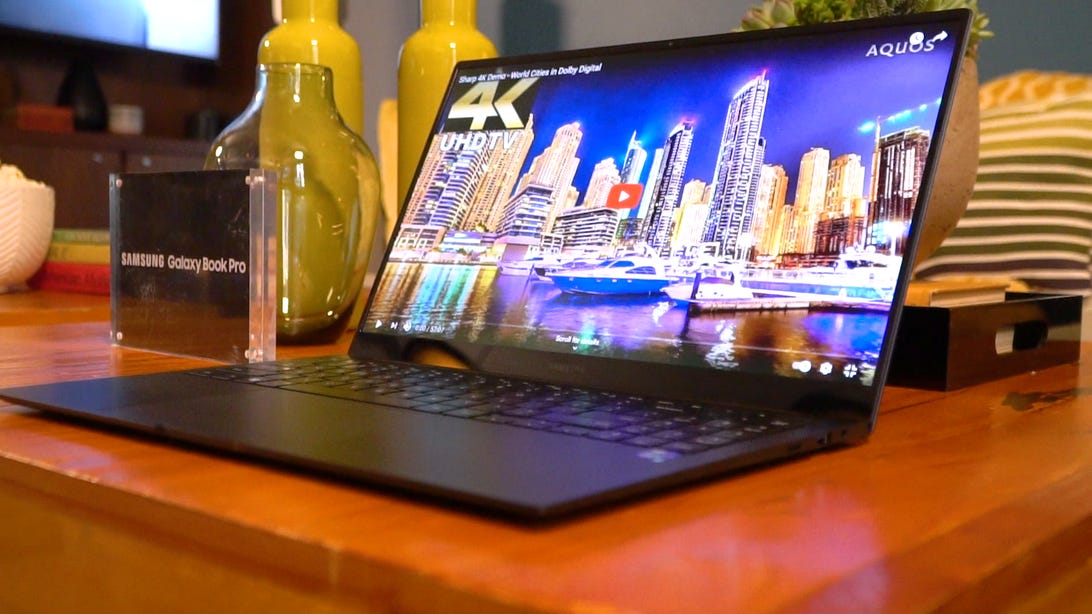
Samsung's Galaxy Book Pro was co-engineered with Intel to deliver a new, unified Galaxy experience.
The pandemic created a huge shift in how -- and where -- a lot of people work and learn. It also accelerated demand for new technology to get things done. The PC market boomed last year in response, with worldwide PC shipments totaling 91.6 million units in the fourth quarter of 2020 alone, according to research firm IDC.
"The PC is essential, whether that's people working from home or learning from home, it's how they communicate with their friends and family, how they collaborate," Gregory Bryant, EVP of the Client Computing Group at Intel, told CNET in a recent video chat. PCs aren't just personal computers now, but a key instrument for enabling people to achieve what matters most to them, what Bryant calls "purposeful computing."
"People have multiple roles during the day," Bryant says. "Sometimes during the day I'm a dad, sometimes during the day I'm a musician, I play the drums. Sometimes during the day, I'm a professional -- it's not a one-size-fits-all thing and during the day a person can play multiple roles, so how do we build purpose-built systems that are optimized for that experience?"
This question is at the heart of what was Intel's Project Athena program and has morphed into the chip-maker's Evo platform. An Evo-verified laptop must meet certain standards for performance, battery life, wireless and wired connections and responsiveness among other things. These standards were designed to meet key experience indicators or KEI that Intel developed after studying PC users and their needs to help them handle their multiple roles throughout the day.
Samsung starts a new Evo chapter
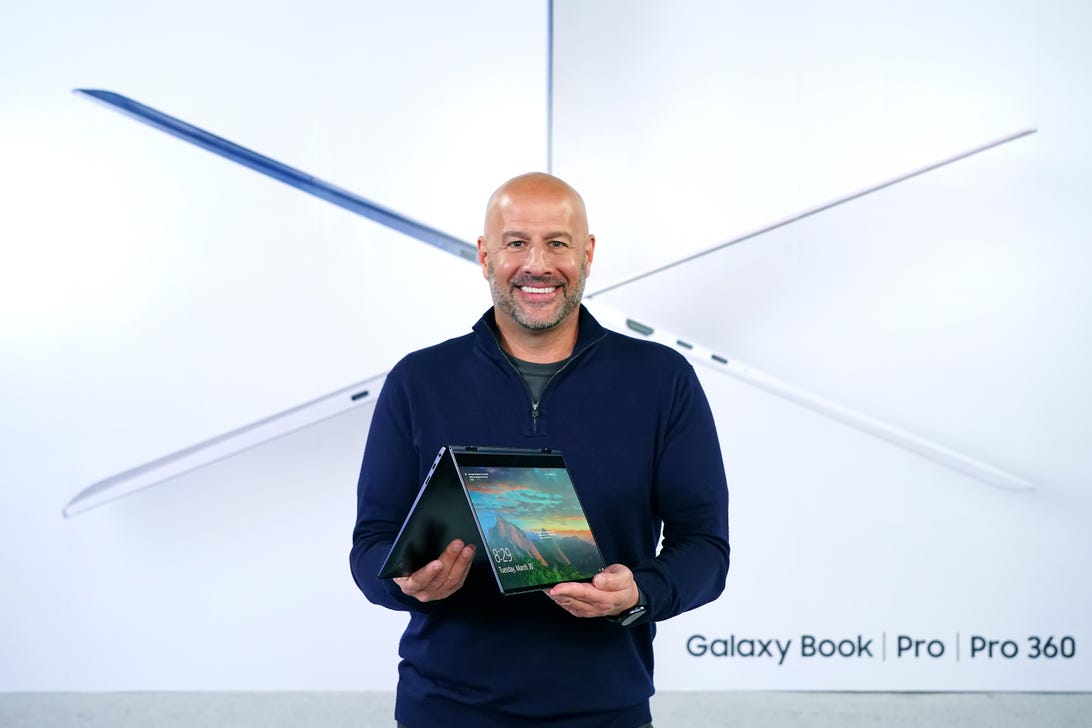
Gregory Bryant, EVP of the Client Computing Group at Intel, with the Galaxy Book Pro 360.
Intel
When Intel started Project Athena, the target user was "the mobile go-getter," and each of the current 75 Evo-verified PCs is co-engineered with Intel to deliver a top mobile experience. However, two of the newest additions, Samsung's Galaxy Book Pro and Pro 360, are the first to push the spec further. The premium PCs are built to bring together the strengths of Intel's PC ecosystem and Samsung's mobile ecosystem to create centerpiece PCs for "mobile-first consumers."
"These are consumers used to being always connected on their phone. And so they want to also be always connected on their PC, and they want all of their devices to sync and work seamlessly together," says Danielle Moten, senior product manager for Samsung. The idea is to have fluidity between devices so you can start something on your phone and continue it on a laptop.
Intel and Samsung spent the last couple of years working together to make this happen, along with help from Microsoft on the software side. For example, the laptops have a custom Bluetooth enablement that allows Galaxy Buds to instantly connect without the process of going into settings and selecting them. With your Galaxy phone, you can connect to the laptop and drag and drop files and content between the two near-instantly. You can also use a Galaxy Tab tablet as a second extended (or mirrored) display and use the laptops to control your SmartThings smart home devices as well as use it to locate your other Galaxy devices.
Now playing:Watch this: Every Galaxy Book revealed at the Samsung Unpacked event
9:55
The end result is seemingly a unified experience with all the devices in Samsung's Galaxy ecosystem. This kind of deep integration between products is something that typically gets attributed to only one company: Apple.
"The strength of Intel and the client computing group is our ability to not just deliver the CPU, but a variety of the system components and then work with third parties to do the deep platform engineering with our customers. It's what we bring to the table and it's really differentiated us."
CNET Weekly News
Get a roundup of tech news, featuring the best and most important stories from each week.
AMD's next-generation Ryzen 6000 CPUs based on the Zen 3+ core architecture and codenamed, Warhol, have reportedly been canceled. The information comes from multiple leakers & insiders whose latest updates suggest that AMD has cut off Warhol from its desktop roadmap and will now be focusing entirely on its Zen 4 Raphael CPUs.
AMD Ryzen 6000 'Warhol' CPUs Based on Zen 3+ 6nm Core Architecture Reportedly Canned, Ryzen 5000 XT Refresh In The Works
The AMD Ryzen 6000 lineup, codenamed Warhol, was expected to feature the Zen 3+ architecture based on the 6nm process node. The lineup would have offered similar gains in performance such as the AMD Zen 2+ (Pinnacle Ridge) chips which were branded as the Ryzen 2000 parts however, it looks like AMD has decided to move away from Warhol and focus on Raphael, its next-generation Zen 4 Desktop CPU lineup.
This is reported by reliable leaker, ExectuableFix, who states that aside from the leaked roadmap, AMD's Ryzen 6000 Warhol lineup hasn't appeared anywhere yet. He states the Zen 4 based AMD Phoenix (Ryzen 7000) APUs have already shown up in other places and a part that comes earlier hasn't even shown up anywhere yet suggests that it no longer exists. On the other hand, another insider has stated that while AMD has cancelled Warhol CPUs, there's still a refresh coming which would be based on the existing Zen 3 core architecture and feature the 7nm process node known as the Ryzen 5000 XT.
I've not seen anything on Warhol. Only that roadmap has mentioned it. Even Phoenix has already been leaked from different places... You can draw your own conclusion based on that 🧐
It is likely that given the current CPU shortages and TSMC's inability to keep up with 7nm demand, AMD decided to skip Warhol CPUs and now focus its efforts on the next-generation AM5 platform featuring the Zen 4 based 5nm Raphael Ryzen CPUs. As mentioned above, there would still be an intermediary refresh for the AM4 platform as several manufacturers are readying X570S boards based on the AM4 socket and X570 chipset. These boards are expected to be announced later in May. Following is a video from Moore's Law is Dead & RedGamingTech which pretty much says the same thing:
As for the refreshed Ryzen CPUs, AMD will be boosting the clock speeds & optimizing them but we shouldn't expect to see any IPC uplifts considering they will be based on the same Zen 3 cores and not the updated Zen 3+ cores. This is all just a rumour for now and there's a chance that Warhol may still exist since the previous Ryzen 3000 Refresh was announced and leaked just days before launch. We will see if that's the case.
AMD Zen CPU / APU Roadmap:
Zen Architecture
Zen 1
Zen+
Zen 2
Zen 3
Zen 3+
Zen 4
Zen 5
Process Node
14nm
12nm
7nm
7nm
6nm?
5nm
3nm?
Server
EPYC Naples (1st Gen)
N/A
EPYC Rome (2nd Gen)
EPYC Milan (3rd Gen)
N/A
EPYC Genoa (4th Gen)
TBA
High-End Desktop
Ryzen Threadripper 1000 (White Haven)
Ryzen Threadripper 2000 (Coflax)
Ryzen Threadripper 3000 (Castle Peak)
Ryzen Threadripper 5000 (Chagal)
N/A
Ryzen Threadripper 6000 (TBA)
TBA
Mainstream Desktop CPUs
Ryzen 1000 (Summit Ridge)
Ryzen 2000 (Pinnacle Ridge)
Ryzen 3000 (Matisse)
Ryzen 5000 (Vermeer)
Ryzen 6000 (Warhol / Cancelled)
Ryzen 6000 (Raphael)
TBA
Mainstream Desktop APU
Ryzen 2000 (Raven Ridge)
Ryzen 3000 (Picasso)
Ryzen 4000 (Renoir)
Ryzen 5000 (Cezanne)
Ryzen 6000 (Rembrandt)
Ryzen 7000 (Phoenix)
Ryzen 8000 (Strix Point)
Low-Power Mobile
N/A
N/A
Ryzen 5000 (Van Gogh)
Ryzen 6000 (Dragon Crest)
TBA
TBA
TBA
TBA
Do you think cancelling Warhol to focus on Ryzen 5000 refresh and Zen 4 Raphael CPUs is going to be a good decision by AMD?



 Intel on stage with Samsung this week talking about its new laptops.


 Intel is behind the dual-screen concept devices seen in 2020.