AMD CPUs have been notoriously disadvantaged in the gaming space vs Intel over the past decade. AMD pushed to get multi-core popular in early 2011, with the Bulldozer architecture. It wasn't until 2017 with 1st Gen Ryzen that AMD began making a comeback. They weren't great at gaming, but AMD's focus to bring both high core counts and good IPC to its CPUs allowed them to start gaining back market share, especially from PC enthusiasts. Now with today's current Ryzen 3000 CPUs, AMD is going toe-to-toe with Intel in gaming benchmarks for the first time ever since 2006, almost beating Intel's Core CPUs.
If AMD's new Zen 3 chips deliver on the promise of high gaming performance, we could see a massive swing in market share over to AMD. We already see AMD making a dent in Intel's market share with notebooks, if they can beat Intel in the gaming race, they'll have all the firepower they need to dominate the consumer space as a whole.
We are heading into the weekend with some rather exciting news on Big Navi, with AMD's next-gen RDNA 2 graphics architecture and new Radeon RX 6000 series graphics cards right around the corner... we have a big new tease on Navi 21.
The news is coming from Moore's Law is Dead (MLID) who says that the new Radeon RX 6900 XT graphics card -- powered by the Navi 21 GPU, will "challenge" NVIDIA's new GeForce RTX 3080. MLID notes that Navi 21 and the RX 6900 XT is "unlikely to win at everything".
Tom also notes that Navi 21 will not "outright win at 4K" against the RTX 3080, but it will have more VRAM (16GB versus 10GB) and have lower power consumption than the RTX 3080. AMD will reportedly be going with GDDR6 on their new cards, and not the higher-end GDDR6X memory.
This isn't a bad thing as we'll still see great performance numbers out of RDNA 2 as it is (thanks to Sony and Microsoft's input in the development of RDNA 2 for the next-gen PlayStation 5 and Xbox Series X consoles). There's an exciting new cache being touted, which Tom explains in the video -- I will cover that in a separate article as it's quite exciting.
As for the price, Tom says that the estimated pricing right now is somewhere between $549 and $699 and notes that there is a huge range there to talk about. He's right -- AMD could be competitive and launch at $549 or $599 being able to say that performance is close to, equal to in some games, and beating in others against the RTX 3080.
It will have more VRAM (16GB versus 10GB) which is a big deal on its own (even if you don't use it, to say your new card -- the RX 6900 XT in this case -- which has similar performance to your competitors' 4K gaming card) is a huge deal for AMD coming back into the enthusiast ring again.
AMD could price the Radeon RX 6900 XT at $599 and beat NVIDIA by $100 against the GeForce RTX 3080, offering similar (and sometimes more) performance, with much more VRAM and lower power numbers. I mean, it sounds like an easy home run for AMD if this is right.
We will find it all out on October 28 when AMD officially details its new RDNA 2 architecture and next-gen Radeon RX 6000 series GPUs.
HP has just announced several new laptops, including the Spectre x360 14 convertible, which brings some notable improvements compared to its already-impressive 13-inch predecessor: a 3:2 aspect ratio display, a 16 percent larger touchpad, quad speakers, and a Thunderbolt 4 port located in one of its diamond-shaped corners so you can plug in your all-in-one cable for charging, data, external monitors and peripherals even if the back or sides of the machine are blocked. There’s also a physical button you can press on the keyboard to block the webcam.
The three-pound HP Spectre x360 14 is equipped with Intel’s latest 11th Gen “Tiger Lake” processors, specifically up to a quad-core 28W Intel Core i7-1165G7 with Intel’s Xe integrated graphics onboard; just one step below the chip that impressed us in a recent Tiger Lake test. HP says the new laptop should be up to 34 percent faster than last year’s Spectre x360 13 model.
An intriguing location for the Thunderbolt 4 port.Image: HP
More impressively, it’s the first Spectre to include a 3:2 aspect ratio display with 20 percent more vertical real estate than the 16:9 screens we’ve had before — and you can pay for an OLED version of the 13.5-inch 3000 x 2000-pixel screen, too, though we’re not sure how much it costs. One of the biggest annoyances we had with its 13-inch predecessor was its 16:9 display, which my colleague Dan Seifert called “cramped” in his review.
HP also claims the new laptop is its “most intelligent PC ever,” and while we’d have to put that to the test, the smarts sound interesting. HP claims the Spectre can detect when it’s in a bag, and use Intel’s Dynamic Tuning to avoid the battery draining or overheating. The x360 14 also includes AI Noise Removal, which is supposed to eliminate background noise from communication apps like Microsoft Teams and Zoom, and there’s an Auto Color feature that can automatically switch the screen’s color space between DCI-P3, Adobe RGB, and sRGB to theoretically make sure you’re looking at the most accurate colors. The company’s claiming up to 17 hours of battery life, but as little as 10 on the i7/OLED model.
The Spectre x360 14 starts at $1,199 (though presumably not with an i7 and OLED screen), and we’re eager to see how it’ll perform against our current best laptop pick, the $999-and-up Dell XPS 13, particularly now that Dell just gave it a Tiger Lake, Xe graphics and Thunderbolt 4 refresh as well. Dell also has a 2-in-1 convertible touchscreen variant that we like, but it’s the 13-inch Spectre x360 that’s been our favorite 2-in-1.
HP’s Spectre x360 14 laptopImage: HP
HP Spectre x360 13Image: HP
HP Envy x360 13Image: HP
HP Envy 13Image: HP
HP’s 13-inch Spectre x360 is also sticking around, with the company announcing a refresh today that adds some of the same Intel 11th Gen CPUs and up to 16.5 hours of battery life — which would actually be lower than the company promised from last year’s model, though Intel’s been trying recently to encourage manufacturers to make more accurate claims (and we still have a long way to go). The updated Spectre x360 13 will start at $1,199 as well, though there’s also an 4K OLED option that’s sure to be far pricier and harder on the battery life (HP claims as little as 10 hours for this model), as well as a 5G variant of the Spectre x360 13 which is launching sometime early next year.
Both Spectres offer pen support, and it looks like some models of the Spectre 14 will come with one in the box.
HP’s cheaper Envy x360 13 is also getting an 11th Gen Intel CPU refresh today, and we’re eager to see how the Intel chips compare to the AMD ones that made it our pick for the best budget laptop you can buy. It’ll also have a fancy Sure View screen option like HP’s excellent but expensive HP Elite Dragonfly, where you can press a button to activate a privacy filter. HP also sells a traditional clamshell laptop called the HP Envy 13, which will also now be equipped with 11th Gen Intel processors. It’ll stick with the same 88 percent screen-to-body ratio as the last refresh, which is two percent less than its competitor the Asus ZenBook 14 UX425EA.
The Envy x360 13 will start at $949.99 in November, and the Envy 13 at $899.99 in October. Both Spectres should arrive in October, though the 5G version of the x360 13 isn’t coming until early 2021. They’ll all offer Wi-Fi 6 support.
The big question about how people behave is whether they’ve got an Inner Scorecard or an Outer Scorecard. It helps if you can be satisfied with an Inner Scorecard.
Warren Buffett
Tech reviewers have seen it for a while now that Intel (INTC) has been lacking in the consumer-focused market, and with AMD's (NASDAQ:AMD) Epyc 7742, Intel started to lack in the server CPU market as well.
Source: YouTube Screenshot, Channel LinusTechTips
Higher core count provides more computing power, and if the workload is distributed evenly across cores, power consumption can also be significantly reduced.
This, in part, shows that Intel lacks technologically, but also with AMD's much lower "price per processing," customers are dragged away from Intel and towards AMD.
Intel lost its drive
Intel is not looking forward anymore; they are just looking left and right at what their competitors are doing. In Intel's Blueprint series, they mentioned the word "competitor" 27 times and "AMD" 12 times. I had the feeling that while watching the event, I learned more about Intel's competitors than about Intel's new chip.
During Nvidia's (NVDA) RTX 30 Series keynote, they did not mention Intel, AMD, or any other competitor even once. They compared their new RTX series solely with their own chips.
AMD mentioned "competitors" eight times during their CES 2020 conference. While watching AMD conferences, it feels more like AMD is honestly enjoying showing their products to provide a better experience to their customers. They compare their chips with their older generation chips, and the majority of their performance metrics are based on their products.
Intel is scared.
At least that's what I interpret from their presentation and how the broader market perceives their actions.
From 2010 to 2018, Intel had a monopoly on processors throughout the PC universe. They made themselves comfortable with their monopoly positions, representing itself in small incremental improvements in their CPUs. I guess that they missed the move to 7nm technology because they got too comfortable with their strong position and now lack a whole generational gap in their offerings.
AMD saw Intel's lack of ambition, and especially with their new CEO, Lisa Su, they focused on their customer's needs, on great products, and great technology. They stepped in where Intel got too comfortable and offered customers performance and great technology focused on their needs. That's also clear when we look at AMD's CPU market share.
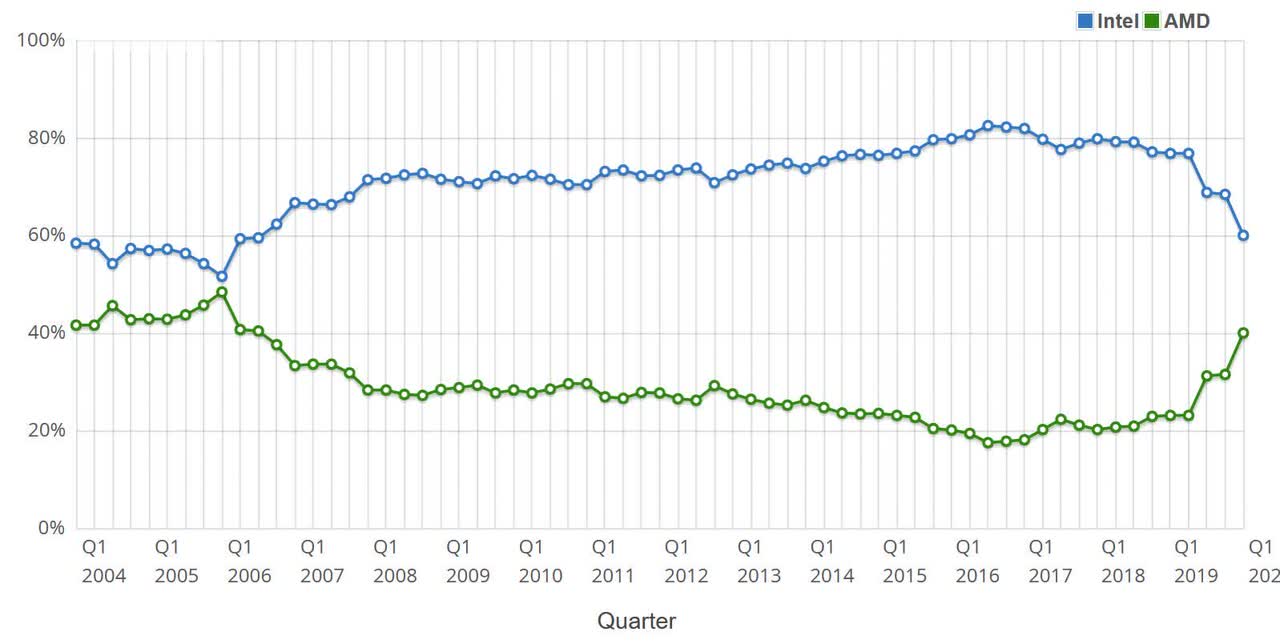
Beginning in 2019, AMD's market share started climbing, and at the beginning of the year, AMD was even able to gain 40% market share in the x86 category.
The market has had enough of Intel comparisons
I closely follow PC hardware review channels like Linus Tech Tips, Gamers Nexus, Hardware Canuck, and a few others. Until the 11th gen Tigerlake, they all agreed that AMD is just hammering the mobile device market with their 4000 Series based on their 7nm architecture.
With Intel's newest presentation of the Tigerlake, Intel managed to make a fool of themselves by talking more about their competitor than about their product.
Source: Author + YouTube Screenshots
Admittedly, AMD does the same to an extent, but Intel brings this whole thing to an entirely new level. It makes Intel look weak and scared in sight of what's to come, especially considering their weakness in multi-core performance.
Intel's 11th gen Tigerlake
Intel sent out laptops with their new CPU to reviewers. They agree that the single-core performance of Intel's 11th gen Tigerlake is fantastic, and its integrated graphics is sufficient to play a wide variety of 3D games on an Ultrabook.
I still have a few questions on who Intel is addressing with their new chip, what's the price point of it, and what's the battery consumption. These are essential questions that'll be answered once they officially launch their new CPU.
Who is the Tigerlake for?
The 11th gen Tigerlake shines with its single-core performance and integrated graphics unit, but even so, a dedicated GPU like the Nvidia MX350 outperforms Intel's integrated GPU. Software that makes use of multiple cores run better on AMD's 4000 series.
Intel advertises that the Tigerlake is made for everyday users and the most commonly used software. Yes, that's true, and Benchmark tests verify that statement. But there is another big reason why customers would choose the Tigerlake against AMD's Ryzen, Laptop Design.
Stated on Intel's Newsroom, more than 150 designs will make use of Intel's 11th gen CPU, which offers customers a variety of choices. AMD still lacks in this perspective.
So what's the result of all the new benchmark tests?
It's single-core against multi-core performance. With Intel's new 11th gen Tigerlake, its single-core performance outshines that of AMD. Single-core performance is handy for applications that don't or can't make use of multiple cores. Microsoft Excel, PowerPoint, or Chrome run mostly single-core and are everyday consumer tools.
Intel lacks at multi-core performance and programs that make use of multi-core architecture run faster and better on AMD chips, and that's the problem Intel is facing. It's just a matter of time when developers will make use of higher core numbers, and distributing the workload across more cores will also reduce the power consumption of the CPU, which is essential for light and portable laptops.
The Intel i7-1185G7 has a lot to offer. Its integrated graphics enables customers to have a laptop that would perform well during everyday tasks and allow them to play 3D games on their laptops. The integrated GPU is not comparable to dedicated graphics cards but performs well enough to satisfy everyday gamers.
Conclusion
For more than ten years, Intel had no real competition in the CPU sector, which mirrors the lack of large generational leaps between their CPUs. With the 11th gen Tigerlake, Intel made a step in the right direction, but its positioning in the light and portable laptop market is still questionable, its price point is unclear, and battery consumption was not stated yet.
With AMD's 7nm architecture, it definitely has the edge against Intel for the time being. Intel announced in its Q2 2020 earnings that we could not expect a 7nm technology from Intel until 2022/2023. AMD has years to improve on its architecture and processes until Intel catches up.
Considering the growth rate of Intel's market and its dividend yield, I would not exclude Intel from my portfolio but tend to weigh more in favor of AMD for the long-term view.
If you liked this article, feel free to click the follow button.
I always welcome constructive criticism and open discussions. Please feel free to comment or PM me about my calculations and/or sources that I use in my articles.
Disclosure:I am/we are long AMD, INTC.I wrote this article myself, and it expresses my own opinions. I am not receiving compensation for it (other than from Seeking Alpha). I have no business relationship with any company whose stock is mentioned in this article.
Additional disclosure: Author note: Seeking Alpha offers me the opportunity to articulate my thoughts and share them with other investors to get feedback and create constructive discussions about anything I say. I am not a financial advisor, and the information provided in my articles should not be used to make investment choices. Due diligence and/or consultation with your investment adviser should be undertaken before making any financial decisions, as these decisions are an individual's responsibility.
Advanced Micro Devices (NASDAQ: AMD) is one of the largest semiconductor companies with a near $100 billion market capitalization. The company's share price has dropped 15% over the past month as the overall technology sector has continued to suffer. Now, the company has announced that it's revealing its new CPU and GPU in October. We discuss the importance of this reveal in this article.
These processors will be built on an improved 7 nm architecture from Taiwan Semiconductor (NYSE: TSM). However, combined with other architecture and process improvements, gains are expected to be in the range of 10-15% minimum. For TSM customers alone, the new node offers 10% power efficiency or 7% performance outside of any other improvements.
Across the board, these are significant performance opportunities. Initial framerate improvements indicate a 30% improvement over the 3800X versus the 5800X. More importantly, over the 10900K and its $530 MSRP (the CPU offers a 5% performance gain versus the 3800X $400 MSRP), the new CPU is expected to have a 25% gain over Intel's (NASDAQ: INTC) performance.
Despite the smaller node offering cost savings, the new node, even if it comes at the same price point, will offer dramatic performance improvements and higher margins. For those comparing it to Intel, it'll offer lower costs, better performance, and better power efficiency. These are all massive.
The above graph shows the market share comparison of Intel versus AMD. AMD's Ryzen processors have performed quite well and have been steadily capturing market share. Intel recently announced its "catch-up" with the 10xxx line of processors, however, the company has been plagued with supply issues making it difficult for the processors to stay near MSRP.
AMD has an opportunity to surpass Intel in performance, even outside of pricing. At the same time, the company can translate the same performance benefits to EPYC. That means the opportunity to expand in the much more lucrative server markets. Overall, this launch is about whether AMD can continue to dominate Intel.
Advanced Micro Devices' Big Navi
The next major upcoming launch for Advanced Micro Devices is its Big Navi GPU. The event of the company's next generation GPUs, also on TSM's 7 nm process, is expected to come on October 28.
Unfortunately, AMD hasn't been performing the same relative to Nvidia (NASDAQ: NVDA) compared to how it's been doing versus Nvidia. Nvidia doesn't own its own foundries so it doesn't suffer the same as Intel with its recent foundry issues that it's suffered. It's used Samsung's (OTC:SSNLF) 8nm process for its recent Ampere GPUs which have made the airwaves with their incredibly popular launch.
The company's last launch with the 2080, was the Radeon VII graphics card, at the same price with lower performance. Big Navi will solve some of that with its RDNA2 architecture including Ray Tracing and other significant benefits. Leaks have tipped Big Navi as being 40-50% faster than the 2080 TI. That's the same performance difference of the 3080 vs. 2080 TI.
The pricing has yet to be revealed, however, with stocking issues and AMD's Big Navi on a much more scaled node, there's a chance that it can be competitive at the same price. Nvidia still has nearly 3x the market share of AMD, which means that Big Navi doesn't need much success to compete, or outperform.
AMD is continuing with ~20% annual revenue growth with a gross margin of >50%. The company is maintaining operating expenses at roughly ~26-27% of revenue. That means an operating margin in the mid-20%'s. As the company moves to smaller and smaller silicon, it means the opportunity at the same price point to improve margins.
Putting this all together, the company expects an FCF margin >15%. Combined with continued revenue growth and the potential for improved margins and it stands to mean the company can become a cash flow giant. That cash flow will enable significant long-term shareholder rewards. The company has a triple-digit P/E ratio and a path to decrease that significantly.
Putting this all together, AMD is incredibly well-positioned financially for the massive month that October 2020 is expected to be.
Advanced Micro Devices' Risk
AMD's risk is through increased competition from its major hardware competitors. The company has managed to outperform Intel, however, the same was true in the late-2000s into the early 2010s. AMD lost its mantel, and Intel continues to be an incredibly large corporation filled with intelligent engineers.
The same could happen. The same is true of Nvidia, which released a peer-leading new GPU that caused major computing sites to have more traffic than Black Friday. These are risks that investors should continuously pay close attention to.
Conclusion
AMD has an impressive portfolio of assets and the company has continued to perform incredibly well. October is potentially the largest month in the company's history as the company announces whether it'll continue to hold its mantle versus Intel and whether its latest GPUs would be more competitive versus Nvidia.
That makes it, after the company's share price recovery these past years, potentially the largest month of the company's history. The company's financials have the potential to remain incredibly strong with improving margins and strong FCF yields. The company has minimal risk, but is a quality long-term investment.
The Energy Forum can help you generate high-yield income from a portfolio of quality-energy companies. Worldwide energy demand is growing and you can be a part of this exciting trend.
Also read about our newly launched "Income Portfolio," a non-sector-specific income portfolio.
Disclosure:I am/we are long AMD, INTC, NVDA, TSM.I wrote this article myself, and it expresses my own opinions. I am not receiving compensation for it (other than from Seeking Alpha). I have no business relationship with any company whose stock is mentioned in this article.
The AMD Ryzen 5 2600X is sure to find itself in a few bargain bins as we head towards the end of the year, but should you be planning a build around this chip? And if so, at what price should you snap one up?
Amazon Prime Day and the Black Friday weekend are waiting to pounce on your wallet, so steel yourself to make some brave decisions about the kind of system you actually want. If you're looking to build a system for a younger member of the family, or as a second rig, then this is exactly the sort of chip you should be looking at.
The imminent announcement of Zen 3 could mean that we'll see resellers trying to get rid of older stock, depending on what AMD actually announces, so we could see prices really driven down on chips like this. You'll need a compatible motherboard as well as a graphics card as there's no integrated graphics here, so bear that in mind when looking for a bargain.
What is the AMD Ryzen 5 2600X?
AMD Ryzen 5 2600X Specs
Release date - April 2018 Architecture - Zen+ Lithography - 12nm Cores/Threads - 6/12 Base Clock - 3.6GHz Boost Clock - 4.2GHz L3 cache - 16MB Socket - AM4 Memory support - DDR4-2933 TDP - 95W Launch price - $230
The Ryzen 5 2600X is a mid-range processor that was originally released over two years ago now. It is built on AMD's Zen+ microarchitecture, which was a subtle, but important improvement over the original Zen architecture. It offers a more power-efficient design, which equates to faster performance, and the memory support is notably better compared to the first-gen chips.
The retail version of the chip comes with the Wraith Spire cooler, which is more than capable of keeping this chip cool at stock settings. It is unlocked though if you want to try your hand at overclocking, although you're going to need to spend more on an aftermarket cooler if you really want to try for this.
What are the alternatives to the Ryzen 5 2600X?
The 2600X has been superseded by the 3600X, which draws on the excellent Zen 2 architecture. Even so, the 2600X is still a very capable chip in its own right. AMD has also released the Ryzen 3 3300X for $120, which may only be a 4-core, 8-thread chip, but it packs a serious punch for the cash. Your only issue is trying to find one to buy.
Alternatively the Intel Core i5 9400F can be picked up for the same sort of money and boasts the same core count, although lacks hyperthreading, so has half the amount of threads and struggles to keep up in multi-threaded applications.
Should I buy the AMD Ryzen 5 2600X and at what price?
There's no question that AMD's Zen 2 architecture is much more refined than Zen+, and it's more feature rich as well, offering support for PCIe 4.0 SSDs and graphics cards. So if you're looking for your main build we'd recommend picking up the newer CPU (or waiting to see what Zen 3 has to offer).
The Ryzen 5 2600X has been available for a while now for around $160, which isn't a bad deal, if nothing special. In the deals last year though, it briefly dropped down to $120, and if that happens again it's worth snapping up, as that's a lot of cores for not much cash. And it'll power your games and more-serious work without issue.


 HP’s Spectre x360 14 laptop Image: HP
 HP Spectre x360 13 Image: HP
 HP Envy x360 13 Image: HP
 HP Envy 13 Image: HP