Rechercher dans ce blog

Tuesday, September 29, 2020

Keysight's (KEYS) PathWave Test Solutions Adopted by MediaTek - Yahoo Finance

proc.indah.link

Keysight Technologies, Inc. KEYS is riding on momentum of its innovative software solutions.

The company recently announced that its PathWave Signal Generation software has been utilized by MediaTek, which is a Taiwan-based notable fabless semiconductor company. The aim was to accomplish physical layer interoperability development testing (IODT) based on 3GPP release 16 5G new radio (NR) criteria.

MediaTek’s Dimensity 5G-integrated chip platform leveraged Keysight’s PathWave Signal Generation for 5G NR software to develop a physical layer algorithm pertaining to 3GPP Release 16 specifications.

The software, also termed Signal Studio, is compliant with the latest 3GPP 5G NR standards. This enables customers, including chipmakers, to design “waveform files for characterization, testing of transmitters and receivers in base stations and wireless devices.”

Markedly, device makers designing products for advanced 5G applications cannot do away with IODT. Moreover, the 3GPP physical layer IODT breakthrough is imperative to the design and development of 5G NR features, including improved multiple-input, multiple-output (eMIMO), dynamic spectrum sharing (DSS), beamforming,  positioning, and carrier aggregation (CA), in advanced applications.

Keysight’s 5G expertise and solutions aid semiconductor companies, such as MediaTek, with innovative 5G testing technologies, which facilitate fast connectivity, low-latency and high reliability, to design superior 5G chip solutions.

Evolving technologies such as multi-cloud architecture, SD-WAN, and software as a service (SaaS) applications, require secure network and robust architecture. Amid the coronavirus crisis triggered remote working wave, it has become imperative for semiconductor companies to deliver robust 5G devices. This requires advanced testing platforms to measure the performance and security of networks and application services.

These factors are expected to bolster the demand for Keysight’s PathWave Signal Generation software, which is easy to implement and operate. This, in turn, will drive the top line in the days ahead.
 

Keysight Technologies Inc. Revenue (Quarterly)

Keysight Technologies Inc. Revenue (Quarterly)

Keysight Technologies Inc. revenue-quarterly | Keysight Technologies Inc. Quote

Further, expanding collaboration with MediaTek is likely to aid the company in expanding presence in Asia Pacific. Notably, Keysight is enabling MediaTek to accelerate validation processes for chipsets pertaining to mmWave and sub-6GHz frequency bands.

Expansion in Portfolio Augurs Well

Keysight, which currently carries a Zacks Rank #2 (Buy), is strengthening its product portfolio with focus on augmenting software testing capabilities. You can see the complete list of today’s Zacks #1 Rank (Strong Buy) stocks here.

During the fiscal third quarter, Keysight concluded the acquisition of Eggplant from The Carlyle Group with an aim to boost software test automation capabilities.

The company is also well poised to gain from incremental adoption of latest support solutions, including Keysight Care that is expected to fuel gross margin expansion in the days ahead. Moreover, incremental adoption of the company’s latest innovative PathWave Test 2021 software holds promise.

Also, robust growth in Software and services revenues, which represented more than 30% of total revenues in third-quarter fiscal 2020, is driving Keysight’s business model, bolstering recurring revenue growth and leading to expansion in gross margins.

Moreover, the company is benefiting from accelerated 5G commercial deployment, which is leading to improvement in orders from 5G device and design developers. Further, expansion of investments in O-RAN (or Open Radio Access Network) and virtualization technologies augurs well.

Increasing investments in 5G infrastructure is fueling demand of its testing and emulation solutions. Moreover, momentum in semiconductor measurement solutions driven by allegiance of semiconductor companies to develop chips on next-generation process technologies bodes well.

These factors position Keysight well to benefit from 5G NR network collaborations with Qualcomm QCOM, Xilinx XLNX and AT&T T. This, in turn, will also help the company in fortifying presence in the global 5G network emulation market.

However, the coronavirus outbreak led global supply chain disruptions and macroeconomic weakness in aerospace and defense vertical, and Huawei related headwinds are anticipated to weigh on Keysight’s near-term prospects.

Just Released: Zacks’ 7 Best Stocks for Today

Experts extracted 7 stocks from the list of 220 Zacks Rank #1 Strong Buys that has beaten the market more than 2X over with a stunning average gain of +24.3% per year.

These 7 were selected because of their superior potential for immediate breakout.

See these time-sensitive tickers now >>


Want the latest recommendations from Zacks Investment Research? Today, you can download 7 Best Stocks for the Next 30 Days. Click to get this free report
 
ATT Inc. (T) : Free Stock Analysis Report
 
QUALCOMM Incorporated (QCOM) : Free Stock Analysis Report
 
Xilinx, Inc. (XLNX) : Free Stock Analysis Report
 
Keysight Technologies Inc. (KEYS) : Free Stock Analysis Report
 
To read this article on Zacks.com click here.
 
Zacks Investment Research

The Link Lonk


September 29, 2020 at 09:25PM
https://ift.tt/36jvv1G

Keysight's (KEYS) PathWave Test Solutions Adopted by MediaTek - Yahoo Finance

https://ift.tt/3e1uOdC
Mediatek

Keysight, MediaTek Achieve Physical Layer Interoperability Development - SDxCentral

proc.indah.link

Privacy Manager

SDxCentral employs cookies to improve your experience on our site, to analyze traffic and performance, and to serve personalized content and advertising relevant to your professional interests. You can manage your preferences at any time. View our Privacy Policy for more information.

The Link Lonk


September 30, 2020 at 06:00AM
https://ift.tt/2SdhxWW

Keysight, MediaTek Achieve Physical Layer Interoperability Development - SDxCentral

https://ift.tt/3e1uOdC
Mediatek

Snapdragon™ apples are back - harvest season underway - FreshPlaza.com

proc.indah.link

SnapDragon™ apples are ripe for picking as harvest season is officially underway. Grown exclusively by Crunch Time Apple Growers, a New York State-based cooperative of 151 growers dedicated to producing the best apples on the market, this year's SnapDragon crop is expected to yield its largest haul yet. The cooperative also announced the addition of direct market growers in five additional states — Michigan, Ohio, Iowa, Pennsylvania and Illinois — starting this year.
"The continued year-over-year growth SnapDragon has experienced has us extremely confident in its performance this season," said Jessica Wells, business manager of Crunch Time Apple Growers. "We know when retailers keep SnapDragon apples on the shelves consistently, consumers keep coming back. We're looking forward to another strong year with our largest crop yet and we're happy to welcome our new farms on board this year."

This fierce variety of apples has demonstrated success among consumers and retailers, selling out every season since its release in 2014. To capture this bottom-line impact, Crunch Time Apple Growers partnered with Category Partners to study three leading East Coast retailers who provided consistent shelf space to SnapDragon during the prime-buying season from December 1, 2019 to March 1, 2020. The findings showed:

  • 75% of premium apple sales are driven by three varieties, and one of them is SnapDragon.
  • SnapDragon performance in volume and dollars was substantially stronger than the composite of the top 10 premium varieties.
  • Retailers that maintained shelf space throughout the season saw consistent sales increases each week, with the most significant gains taking place in the third month of sales.
  • For retailers, revenue and volume consistently increased, indicating positive consumer reaction and sales performance built on repeat purchases.

"It comes down to the nature of the apple," said fifth-generation farmer, Joel Crist of Crist Bros. Orchards Inc. and Crunch Time Apple Growers board chair. "Its crunchy texture and sweet taste are extremely appealing. Coupled with a spicy undertone and hint of vanilla, SnapDragon makes for a unique eating experience that you just don't find in other apple varieties."

For more information:
Crunch Time Apple Growers
Tel: (716) 300-8071 
www.snapdragonapple.com
www.crunchtimeapplegrowers.com 

The Link Lonk


September 29, 2020 at 06:55PM
https://ift.tt/2Gmmj1A

Snapdragon™ apples are back - harvest season underway - FreshPlaza.com

https://ift.tt/3gnoK0A
Snapdragon

Intel: The Market Is Missing The Point - Seeking Alpha

proc.indah.link

Intel to remove old drivers and BIOS updates from its site by the end of the week | ZDNet

Source: zdnet.com

Introduction

Intel (INTC) finds itself in a situation very similar to what Microsoft (MSFT) and IBM (IBM) were ten years ago. For many years, Intel has dominated the CPU markets, and its PC-centric business became a cash cow (low to no-growth expected going forward). However, with its dominance in PC markets under severe threat from AMD (AMD) (and now Nvidia+Arm (NVDA)), the semiconductor giant needs to rapidly evolve if it wants to deliver robust shareholder returns over the upcoming decade.

In my opinion, Intel's strategic transformation to a data-centric company has the potential to generate steady revenue growth over the next ten years, similar to what Microsoft achieved in the 2010s and what IBM has heretofore failed to do. With continued revenue growth, I expect Intel's free cash flow to trend higher, which will correspondingly drive its share price higher.

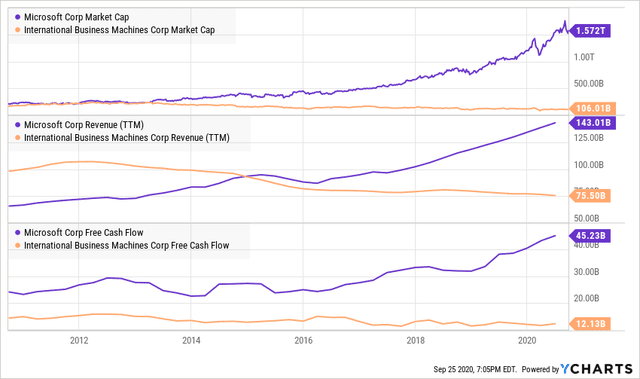
In the image that follows, I juxtapose IBM's performance with Microsoft's over the last ten years.

Microsoft IBM combinedSource: YCharts

Companies that fail to perpetually reinvent themselves stagnate, and as a result, their shareholders suffer. A look at the chart above exemplifies this idea. In the last ten years, Microsoft saw a resurgence, while IBM went through a slow decline. Now, both of these tech giants continued to make a lot of money, but Microsoft's stock became a 15X bagger while IBM's share price declined 20%. So, what does the future hold for Intel? Will it be the next IBM or Microsoft? Here's are my thoughts:

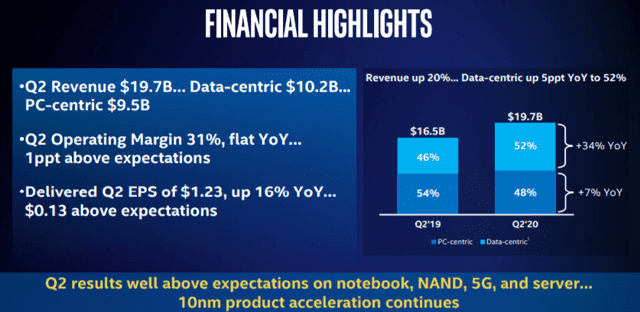
  • Intel's data-centric business now contributes more than 50% of total revenues and grew from $7.59 billion to $10.24 billion (up 35% y/y) last quarter.
  • The demand for Intel's data-centric products should remain elevated for the foreseeable future as numerous secular growth trends viz. hyperscale cloud, enterprise digital transformation, 5G, IoT, AI, and autonomous vehicles continue to accelerate around us.
  • Intel will continue to deliver single-digit revenue growth over the next decade on the back of the strength in its data-centric businesses. This revenue growth will drive free cash flow and, correspondingly, its share price higher.
  • Critics and skeptics of Intel continue to point to its loss of market share in the PC segment as evidence of its decline, but I believe that Intel's ceding of market share in that market is strategic and by design.
  • Hence, I believe Intel's trajectory will more resemble Microsoft's than IBM's, but perhaps only because it is so centrally at the heart of so many secular growth trends that it will struggle to perform poorly. Intel's management and ability to execute have both been abhorrent as of late.

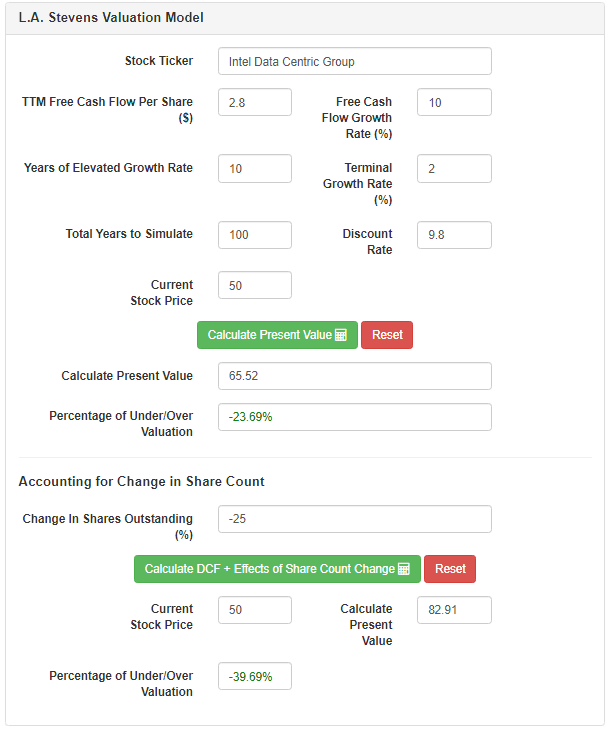
According to my estimates, and granted Intel does not continue to execute abhorrently time and time again, Intel's data-centric business alone is worth $355 billion (or $83 per share). Hence, the stock is significantly undervalued, and as a result, I rate Intel a buy at $50.

Today, we will explore Intel's data-centric business in greater depth, after which we will run it through the L.A. Stevens Valuation Model to ascertain its intrinsic value.

A Look At Intel's Evolution

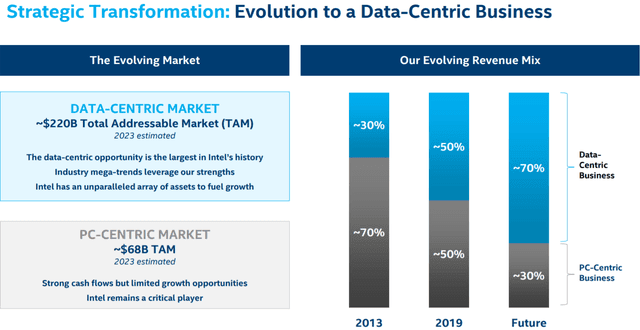
Considering the limited growth opportunity in the PC-centric market, Intel's management proposed a strategic transformation towards a data-centric future in 2017. We know that with the advent of 5G and other emerging trends like cloud computing, IoT, AI, and enterprise digital transformation, the data-centric market will grow in size over the next few years.

Source: Intel 2020 Spring Stockholder Outreach Presentation

According to Intel, the data-centric market could have a TAM of $220 billion by 2023, while the PC-centric market TAM will be $68 billion. Assuming Intel manages to hold onto the majority of the market share in PCs, the change in revenue mix shown in the graph above should result in robust revenue growth in Intel's data-centric business. And the latest quarterly numbers serve as evidence.

Source: Intel Q2 Earnings Presentation

In Q2 2020, Intel's data-centric business revenues grew from $7.6 billion to $10.2 billion (up ~35% y/y). This strength in the data-centric business powered the total revenues higher by 20% y/y. Moreover, the revenue mix has shifted drastically, and Intel can now be looked at as a data-centric business.

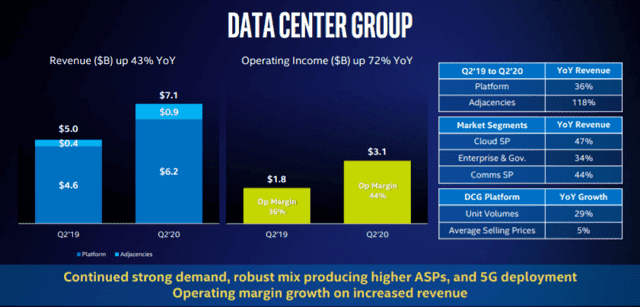
The primary driver of Intel's revenue growth was the data center group [DCG] that witnessed strong demand and higher ASPs. A closer look at DCG shows massive growth across all the market segments (Cloud - 47%, Enterprise & Gov. - 34%, and Comms SP - 44%). Hence, Intel's products remain in high demand in the data center, notwithstanding the relentless chorus of bearish theses at present.

Source: Intel Q2 Earnings Presentation

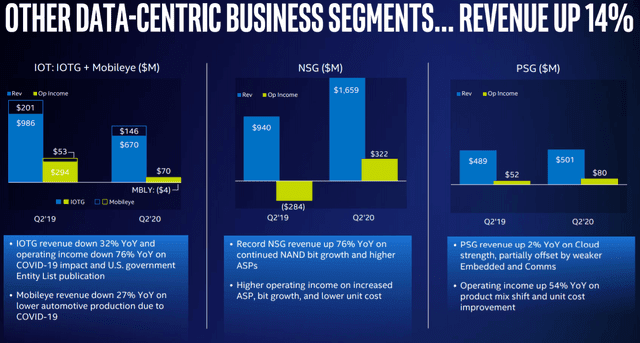
Now, Intel's data-centric business involves a few other assets/groups, namely IoT, NSG, and PSG. The IoT group consists of futuristic assets like Mobileye (autonomous vehicles). For now, the revenues from IoT remain negligible, but investors should keep an eye on the progress of this group to monitor Intel's success in the autonomous vehicle market.

Source: Intel Q2 Earnings Presentation

The NSG group consists of Intel's memory products, and the explosive growth in data should continue to drive the demand for these products higher. Last quarter, NSG revenue grew by 76% y/y to a record figure of $1.66 billion.

Over the next few years, I expect to see the growth in Intel's data-centric business to remain healthy. However, in the face of rising competition from traditional rivals - Nvidia and AMD and new entrants (cloud companies) like Apple (NASDAQ:AAPL), Amazon (NASDAQ:AMZN), Google (NASDAQ:GOOG) (NASDAQ:GOOGL), and Facebook (NASDAQ:FB), I will be using a conservative growth rate of 10% for valuation purposes.

Valuing Intel's Data-Centric Business

In this section, I will be valuing Intel's data-centric business on a standalone basis. To do so, I will be utilizing the L.A. Stevens Valuation Model. Here's what it entails:

  1. Traditional discounted cash flow Model using free cash flow to equity discounted by our (as shareholders) cost of capital.
  2. Discounted cash flow model including the effects of buybacks.
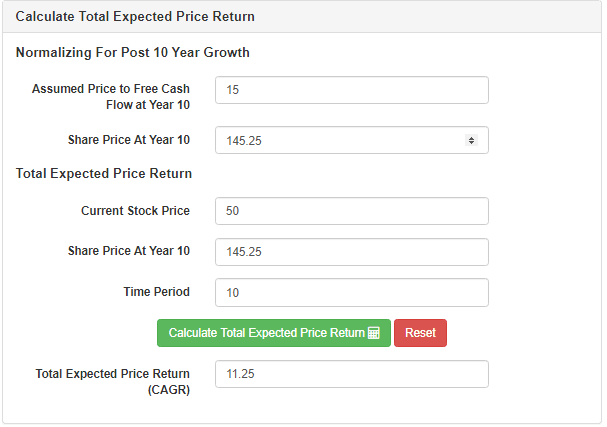
  3. Normalizing valuation for future growth prospects at the end of 10 years. (3a.) Then, using today's share price and the projected share price at the end of 10 years, we arrive at a CAGR. If this beats the market by enough of a margin, we invest. If not, we wait for a better entry point.
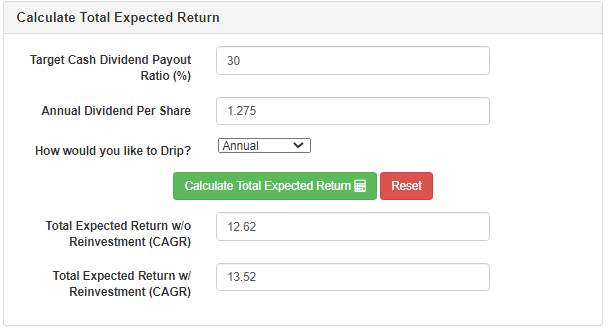
  4. Assessing the impacts of dividends and the growth thereof on total expected return.

Here are the results:

Assumptions Value
Data-centric revenue $40B
FCF Margin (Long Term) 30%
Shares outstanding 4.284B

Source: L.A. Stevens Valuation Model

As you can see above, Intel's data-centric business is worth $82.91. Hence, the market is grossly mispricing the semiconductor giant. For the purpose of experimentation, let's assume Intel's PC centric business does not exist. Let's project the expected returns for Intel (data-centric business only).

To determine the total expected returns (of the data-centric business only), we must project the growth of free cash flow per share for the next ten years. To do so, I grew the aforementioned free cash flow per share and multiplied it by a conservative price to FCF ratio of 15x. Intel trades at a Price to FCF multiple of ~10x right now, but such a discount may not last very long.

Source: L.A. Stevens Valuation Model

So, if one were to buy Intel at $50 and hold for ten years, he/she could expect share price appreciation at 11.25% CAGR. Considering Intel's sizable dividend, the total expected return without dividend reinvestment is 12.62% CAGR, and the total expected return with dividend reinvestment is 13.52% CAGR.

These returns are considerably higher than the 90-year annualized S&P 500 return rate, and they do not even account for Intel's PC-centric business. Hence, I expect Intel to outperform the S&P 500 over the next decade. Thus, I recommend dividend growth investors to make most of this opportunity by adding Intel to their portfolios.

Concluding Remarks

The threat of ARM-based chips looms large over Intel's data center aspirations; however, for now, Intel continues to dominate the market. Furthermore, the demand for 5G, IoT, and AI products is likely to grow over the next decade or so, and Intel will benefit from these secular trends.

Over the next few years, Intel could very well cede market share to rivals like AMD and Nvidia; however, the massive growth of the data-centric market ($220 billion TAM) could lead to increased revenue and free cash flow. According to my estimates, Intel's data-centric business is worth $83 per share on a standalone basis. Hence, an investor buying Intel today is purchasing the data-centric business at a deep discount and getting the cash cow (PC-centric business) for free.

With modest revenue growth and aggressive capital return programs, Intel could quite comfortably deliver double-digit returns over the next decade. Thus, I believe Intel is more likely to be closer to Microsoft than to the IBM of the 2020s; however, management remains a strong concern of mine, and I will be monitoring the developments in that realm over the coming years.

Key Takeaway: I rate Intel a buy at $50.

Let me know what you think in the comments below!

Thanks for reading; remember to follow to get more stock ideas; and happy investing!

Disclosure: I/we have no positions in any stocks mentioned, and no plans to initiate any positions within the next 72 hours. I wrote this article myself, and it expresses my own opinions. I am not receiving compensation for it (other than from Seeking Alpha). I have no business relationship with any company whose stock is mentioned in this article.

The Link Lonk


September 29, 2020 at 09:40PM
https://ift.tt/3cJz7LN

Intel: The Market Is Missing The Point - Seeking Alpha

https://ift.tt/2YXg8Ic
Intel

AMD Ryzen 7 5800X leak shows a powerhouse gaming CPU that could embarrass Intel’s Core i9-10900K - TechRadar

proc.indah.link

AMD’s Ryzen 7 5800X has been spotted in a game benchmark where the purported chip put up a very impressive performance compared to Intel’s current flagship Core i9-10900K, getting AMD fans excited that this CPU could be a real winner in terms of its price/performance ratio.

The Ryzen 5800X was spotted in an Ashes of the Singularity benchmark (as ever, bear in mind the usual caveats about early leaks and authenticity), with the processor being an eight-core effort as previous rumors have claimed.

Sadly the clock speeds aren’t detailed for the 5800X – and neither are the systems in the compared results, save for the graphics cards, which are both RTX 2080 models (and the AMD PC has double the system RAM) – but the 5800X manages to notch up a score of 5,800 (and 5,900 in another run) at 4K ‘crazy’ settings, roughly equal to the Core i9-10900K. The Ryzen chip also hit 6,300 at 1080p.

GPU bottleneck

Drilling down and looking at the CPU frame-rate in the results (highlighted by Wccftech) – in other words, sidestepping the GPU bottleneck caused by the RTX 2080 in the intensive 4K benchmark – shows more like a 15% advantage in favor of the Ryzen processor (averaged over the different batch results).

That’s pretty huge, of course, considering Intel’s Comet Lake champ is capable of boosting to 5.3GHz and has two more cores than the purported eight-core Ryzen 5800X. And if AMD retains a similar pricing structure to existing Ryzen CPUs, and the asking price of the 3800X; well, you can see why folks are starting to get excited…

Still, we should temper our expectations as with any leak, and bear in mind that this is just a specific scenario in a single game benchmark, and there’s much more to gaming performance than just a snapshot like so.

This spilled benchmark is also further evidence that AMD is going to use the Ryzen 5000 name for its range of next-gen Zen 3 processors, essentially to reverse the order in which the CPUs come out for the incoming 5000 series, so that desktop chips hit first, and then Ryzen 5000 mobile.

Also, it represents another nail in the coffin for the vague notion floated that the 5800X might move up to 10-cores (although theoretically there could still be a 10-core CPU, of course, elsewhere in the range).

The Link Lonk


September 29, 2020 at 08:20PM
https://ift.tt/3kZy3q4

AMD Ryzen 7 5800X leak shows a powerhouse gaming CPU that could embarrass Intel’s Core i9-10900K - TechRadar

https://ift.tt/2YXg8Ic
Intel

AMD Ryzen 7 5800X leak shows a powerhouse gaming CPU that could embarrass Intel’s Core i9-10900K - TechRadar

proc.indah.link

AMD’s Ryzen 7 5800X has been spotted in a game benchmark where the purported chip put up a very impressive performance compared to Intel’s current flagship Core i9-10900K, getting AMD fans excited that this CPU could be a real winner in terms of its price/performance ratio.

The Ryzen 5800X was spotted in an Ashes of the Singularity benchmark (as ever, bear in mind the usual caveats about early leaks and authenticity), with the processor being an eight-core effort as previous rumors have claimed.

Sadly the clock speeds aren’t detailed for the 5800X – and neither are the systems in the compared results, save for the graphics cards, which are both RTX 2080 models (and the AMD PC has double the system RAM) – but the 5800X manages to notch up a score of 5,800 (and 5,900 in another run) at 4K ‘crazy’ settings, roughly equal to the Core i9-10900K. The Ryzen chip also hit 6,300 at 1080p.

GPU bottleneck

Drilling down and looking at the CPU frame-rate in the results (highlighted by Wccftech) – in other words, sidestepping the GPU bottleneck caused by the RTX 2080 in the intensive 4K benchmark – shows more like a 15% advantage in favor of the Ryzen processor (averaged over the different batch results).

That’s pretty huge, of course, considering Intel’s Comet Lake champ is capable of boosting to 5.3GHz and has two more cores than the purported eight-core Ryzen 5800X. And if AMD retains a similar pricing structure to existing Ryzen CPUs, and the asking price of the 3800X; well, you can see why folks are starting to get excited…

Still, we should temper our expectations as with any leak, and bear in mind that this is just a specific scenario in a single game benchmark, and there’s much more to gaming performance than just a snapshot like so.

This spilled benchmark is also further evidence that AMD is going to use the Ryzen 5000 name for its range of next-gen Zen 3 processors, essentially to reverse the order in which the CPUs come out for the incoming 5000 series, so that desktop chips hit first, and then Ryzen 5000 mobile.

Also, it represents another nail in the coffin for the vague notion floated that the 5800X might move up to 10-cores (although theoretically there could still be a 10-core CPU, of course, elsewhere in the range).

The Link Lonk


September 29, 2020 at 08:20PM
https://ift.tt/2GhpyYf

AMD Ryzen 7 5800X leak shows a powerhouse gaming CPU that could embarrass Intel’s Core i9-10900K - TechRadar

https://ift.tt/2ZDueh5
AMD

AMD To Strongly Benefit From New AI And Gaming Chips From Nvidia And AMD - Seeking Alpha

proc.indah.link
[unable to retrieve full-text content]AMD To Strongly Benefit From New AI And Gaming Chips From Nvidia And AMD  Seeking Alpha The Link Lonk


September 29, 2020 at 09:08PM
https://ift.tt/2S6hc8w

AMD To Strongly Benefit From New AI And Gaming Chips From Nvidia And AMD - Seeking Alpha

https://ift.tt/2ZDueh5
AMD

Featured Post

Intel Falls on Latest Server Chip Delay; Rival AMD Gains - Yahoo Finance

proc.indah.link (Bloomberg) -- Intel Corp. fell after saying a new version of its Xeon server chip line will go into production in 2022, r...

Popular Posts